By Honey · Updated September 8, 2026
Honey’s honest pick
Silicone for most kitchens. Stainless steel if the fit is right and the finished look matters more to you.
Nobody wakes up excited about buying a stove gap cover.
Then one piece of onion disappears between the stove and counter, and suddenly we’re comparing gap fillers on Amazon like this was always part of the plan.
My pick is silicone. Unless you have a very uniform gap and really care about the stainless look, I would save the money and buy the flexible version.
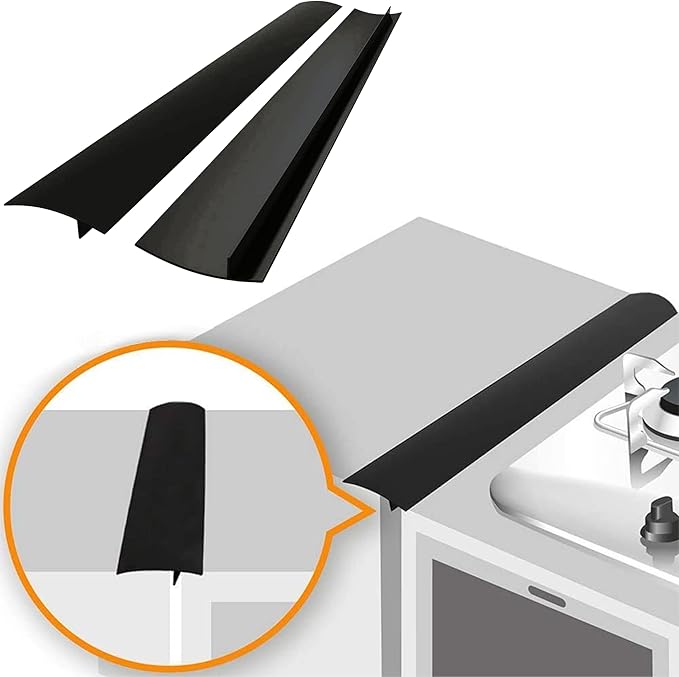
Linda’s Essentials sells silicone covers that can be trimmed to length and removed for cleaning. Its stainless steel version adjusts in length and gives you a more finished look.
Silicone is generally more forgiving of small irregularities. That does not mean either cover fits every kitchen: measure the length and width of the gap and check whether the stove and counter are level before ordering.
Affiliate disclosure: As an Amazon Associate I earn from qualifying purchases. I may earn a commission if you buy through one of my links. That does not buy anybody a glowing review.
Silicone vs. stainless steel stove gap covers: the side-by-side
| What matters | Silicone stove gap cover | Stainless steel stove gap cover |
|---|---|---|
| Fit | Flexible; more forgiving of small irregularities | Rigid; dimensions and surface alignment matter |
| Length of linked product | 21 in; can be cut shorter | Adjustable from 13.8 to 27.5 in |
| Gap width | Check the silicone listing’s fit diagram | 2–17 mm (about 0.08–0.67 in) |
| Can it be trimmed? | Yes, following product instructions | Use its length adjustment |
| Cleaning | Remove and wash; linked silicone model is dishwasher-safe | Wipe clean or remove as instructed |
| Look | Simple and unobtrusive | More like an appliance trim piece |
| Installation | Place in a compatible gap | Adjust to a compatible gap |
| Best fit, in my view | Most ordinary kitchens | Kitchens suited to the stainless finish |
| Value | My budget pick | Paying more for the finished look |
| Honey’s winner | WINNER — my pick for most people | My appearance-first option |
Product details checked September 8, 2026 against the linked Linda’s Essentials listings. This is a comparison of materials, dimensions and my buying priorities, not a hands-on durability test. Prices and available sizes can change.
Linda’s Essentials silicone covers, 21-inch black pair. Product image from the linked Amazon listing.
Why silicone gets my vote
This may be the least glamorous product I recommend all year. I am fine with that.
A gap cover between the stove and counter solves a very specific problem: people are tired of trying to retrieve food from a crack that no human hand was designed to reach.
Silicone solves it without making the project more complicated than the problem.
Stainless steel looks nicer to me when it matches the range. If I had a beautiful stainless appliance with perfectly even counters on both sides, I might spend more for it.
Otherwise? Give me the inexpensive flexible strip that I can cut, wash and forget about.
Not everything needs an upgrade.
Before you put either one in, follow the range’s clearance instructions and the cover’s fitting directions. A gap filler belongs beside the stove; it must not cover a vent or touch a flame or heating element.
My final answer: Buy the silicone stove gap cover if it fits your kitchen. Choose stainless if the appearance matters enough to justify it.
Love,
Honey
 Honey, Be Honest
Leave a comment