The Verdict
Before anybody lets an electric sharpener eat a perfectly good chef’s knife, we are checking the damn angle. Shiny machine first, knife facts later is exactly how expensive mistakes happen.
The best electric knife sharpener starts with the angle of the knives you already own. For a mixed collection of compatible 15- and 20-degree blades, Chef'sChoice 1520 is my Amazing choice. The 15XV is Good when you want to maintain 15-degree edges or deliberately convert suitable knives to that edge. Model 120 is Mid for a mixed-angle drawer, but a sensible dedicated choice for compatible 20-degree knives.
This is a manufacturer-researched comparison, not an HBH cutting test. I checked current product information and exact Amazon listings on September 20, 2026. No tomatoes were harmed in the making of an imaginary demonstration. More importantly, no expensive knife needs to become collateral damage because a buying guide treated every shiny blade as interchangeable.
| Exact model | HBH fit | Practical difference |
|---|---|---|
| Chef'sChoice 1520, white (paid link) | Amazing: mixed angles | Separate 15° and 20° sharpening routes |
| Chef'sChoice 15XV, gray (paid link) | Good: a 15° setup | Maintains 15°; deliberate suitable conversions |
| Chef'sChoice Model 120, white (paid link) | Mid: mixed-angle drawer | Dedicated compatible 20°-class knives |
Read the knife before you buy the machine
The model number printed on your knife or its maker's documentation matters more than the country a brand sounds as if it comes from. Modern knife collections cross traditional categories. Do not assume every European-brand blade needs 20 degrees or every Japanese-brand blade needs the same treatment. Identify the actual edge specification and sharpening instructions.
The angles in this comparison describe the manufacturer's sharpening angle per side for ordinary compatible double-bevel blades, not the full included angle across both sides. A 15-degree-per-side edge corresponds to a 30-degree included angle. That is geometry, not proof that a smaller number is universally better for every steel, thickness, or kitchen task.
The exact shopping links here lead to the white 1520, gray 15XV, and white Model 120. Check the model and voltage on the offer you choose. This article is not comparing every machine sold under the Chef'sChoice name, and a different finish should not be used as permission to quietly swap in a different model.
Amazing: 1520 when you actually need two angle options
Chef'sChoice's 1520 manual describes a 15-degree sharpening stage, a separate 20-degree stage, and a finishing stage. The correct route depends on the blade. The two angle choices are why it is my favorite here for a mixed collection: it can address different compatible edges without making conversion the default plan.
The benefit is preserving a deliberate choice. You can maintain an appropriate existing edge instead of buying a fixed-angle machine and discovering afterward that half your drawer was not invited. That matters more to me than a sweeping “professional results” claim. Professional results usually involve somebody knowing what the hell they are doing, even when a motor is present.
The drawback is that you still need to select the right path. Three stages do not mean every knife goes through all three in numerical order. A person who skips the manual and enthusiastically drags every blade through every slot has not purchased convenience; they have purchased a faster way to improvise.
I would buy the 1520 when I had confirmed a real need for both angle categories. If the household uses only compatible 15-degree knives, the added angle choice may not solve a problem. If the knives are specialized, fragile, heavily damaged, or require a sharpening method their maker specifically recommends, seek that guidance before buying any pull-through machine.
Good: 15XV for a deliberate 15-degree setup
The 15XV uses a three-stage process and is designed around a 15-degree edge. Chef'sChoice says it can maintain existing suitable 15-degree blades and convert traditional 20-degree edges to its 15-degree configuration. Diamond abrasives perform the shaping and sharpening work, followed by a polishing stage.
That makes sense for a cook who understands the intended result and wants to maintain an appropriate collection consistently. I would not choose it merely because “15” sounds newer than “20.” A conversion changes the edge, and you should decide whether that is appropriate for the knife and how you use it before material comes off.
The practical drawback is that this is not the same flexibility as separate 15- and 20-degree sharpening choices on the 1520. If preserving a compatible 20-degree edge is the goal, buying a machine whose selling point includes converting it is a fairly direct way to miss your own brief.
For a household ready to use 15-degree edges on suitable knives, the 15XV is the focused choice. For someone who owns a cherished blade and cannot find its maker's instructions, my first purchase would be information. A motorized shortcut does not become reversible because the product page was persuasive.
Mid: Model 120 when your drawer has mixed edge angles
Chef'sChoice Model 120 is designed for 20-degree-class knives. Its manufacturer describes coarse and finer abrasive stages followed by finishing, with guides to position the blade. This is a dedicated option, which can be exactly right when your compatible everyday collection matches that angle.
My Mid verdict is specific to a mixed-angle household. The 120 does not provide the 1520's separate 15-degree route. If you have several compatible 15-degree knives, that limitation is central rather than a minor footnote. A machine is not “best for everyone” simply because the instructions can be printed on a small card.
The reason to buy it is clarity: you want to maintain an appropriate 20-degree collection, and the model's approach fits your routine. The reason to pass is equally clear: you need another angle or your knife maker recommends a different sharpening system. Do not buy this model and then make your knives change their entire identity to justify the purchase.
As with the other two, claims about speed or long-lasting edges are manufacturer descriptions rather than measured HBH outcomes. How a knife performs afterward depends on the blade, its previous condition, the procedure, and later use. I have not run an edge-retention test and will not decorate the article with a pretend score.
The angle graph tells you compatibility, not quality
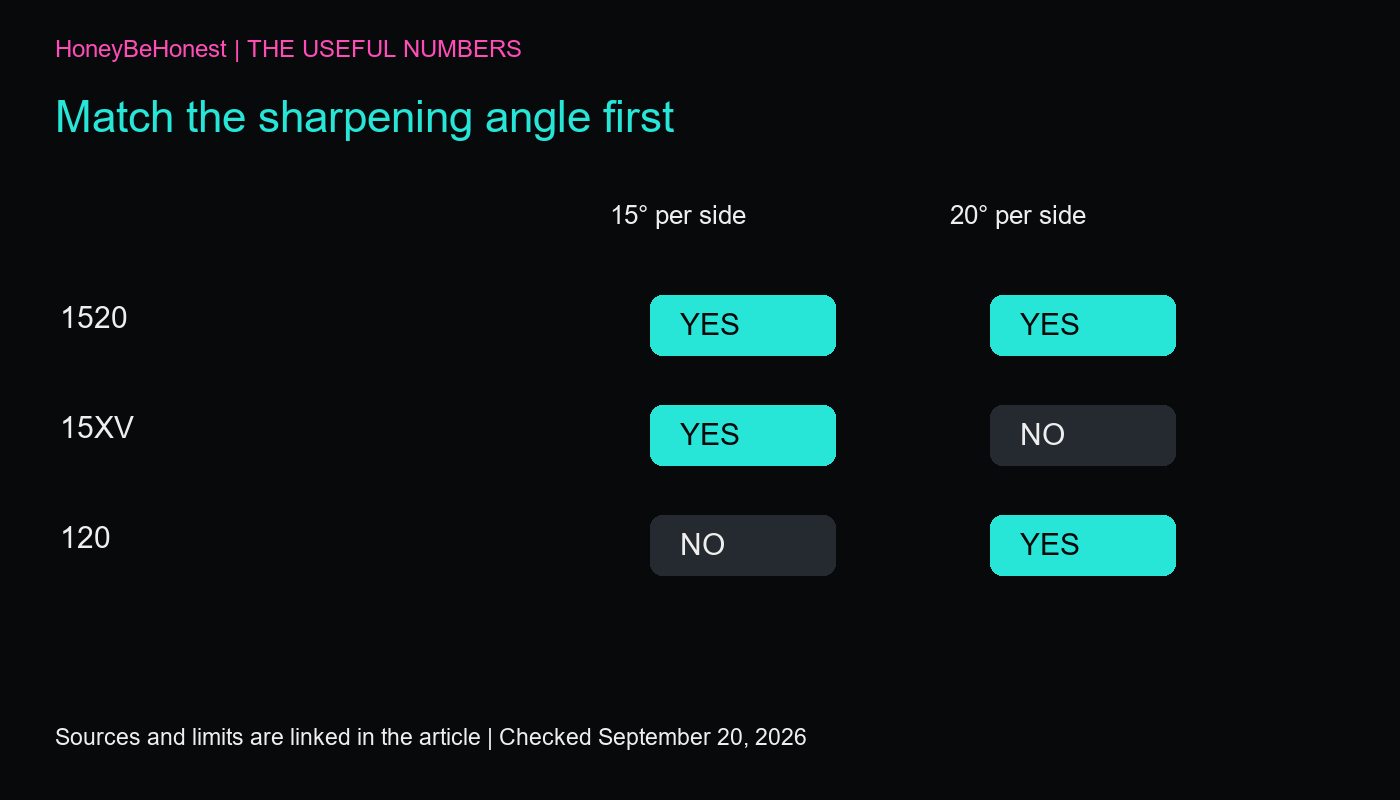
Our graph maps the supported ordinary sharpening-angle choices: 15 and 20 degrees for the 1520, 15 degrees for the 15XV, and 20 degrees for the 120. A mark in a column represents a documented option. It is not a star rating, sharpness measurement, or prediction of how many onions you can chop before another touch-up.
This visual is deliberately less dramatic than a chart declaring a winner by 97.4 points. It answers the question that can prevent a wrong purchase. Sometimes the useful graph is the one that stops us from buying the impressive-looking thing that does the wrong job.
Things the shopping button cannot decide
Can I sharpen a serrated bread knife?
The manufacturer provides special serrated-blade instructions for these models. That does not mean running a serrated blade through the ordinary coarse sequence. Read the exact manual's appropriate finishing procedure and the knife maker's guidance. Serrations deserve their own instructions, not a confident shrug.
What about ceramic knives or scissors?
Do not assume compatibility. These are not universal tools for every edge in the house. Follow the explicitly supported uses in the model manual and choose equipment designed for the material or tool you have. A pair of scissors and a chef's knife do not share an identity just because both can ruin your day when handled carelessly.
How much pressure should I use?
Follow the specified technique and practice the instructed movement before powering through a valuable blade. Extra force is not a substitute for the correct angle or sequence. Keep the appliance stable, handle clean knives appropriately, and use the manufacturer's maintenance instructions rather than improvising lubricants or cleaning methods.
I would choose 1520 for confirmed mixed-angle needs, 15XV for a deliberate compatible 15-degree setup, and Model 120 for dedicated compatible 20-degree upkeep. Buy for the knives you own. The tomato can wait while we read the manual.
Check the exact models
View Chef'sChoice 1520, white on Amazon (paid link)
View Chef'sChoice 15XV, gray on Amazon (paid link)
View Chef'sChoice Model 120, white on Amazon (paid link)
Sources and related reading
Model 1520 manufacturer information
15XV manufacturer specifications
Model 120 manufacturer specifications
Manufacturer manuals for each model
Manufacturer edge-angle explanation
For another counter-space decision, read our Ninja Air Fryer Pro XL vs COSORI TurboBlaze comparison.
Honey’s Bottom Line
Knife-sharpener rule: the knife does not know what the marketing department promised. It only knows its edge angle. Honey would rather measure twice than turn a favorite chef’s knife into an expensive butter knife.
Disclosures
Affiliate disclosure: As an Amazon Associate I earn from qualifying purchases. When you use an Amazon link in this article, HBH may earn a commission at no extra cost to you.
Editorial disclosure: This is a research-based comparison using published manufacturer information and the linked product listings. Unless specifically stated, this is not a report of hands-on testing or personal use.
Artwork disclosure: The cover image is AI-generated Honey Be Honest editorial artwork and is illustrative; it is not a photograph of the exact products compared.


Leave a comment