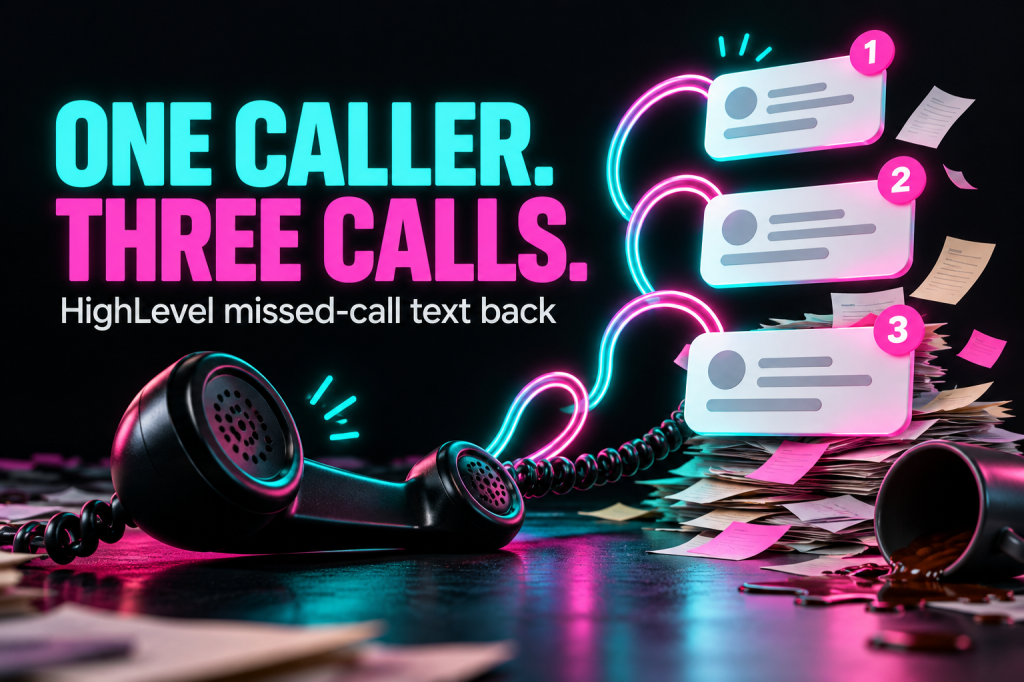
HighLevel’s built-in missed-call text back can send a message for every missed call, including repeat attempts from the same person. Before you switch it on, decide whether that is the conversation you want. Three calls from one anxious customer should not accidentally become your business auditioning as a notification machine.
Honey’s quick take
Amazing: a clearly owned follow-up process. Someone knows who reads replies, when to call back and what the message promises.
Good: the built-in feature when its documented per-call behavior fits your business.
Mid: switching it on and assuming the automation understands your staffing, opening hours and customer’s patience.
Affiliate disclosure: HBH may earn a commission if you purchase through our paid links, at no extra cost to you. That does not make the software the right purchase for everybody.
The detail to check before the demo impresses you
HighLevel’s setup guide, updated September 7, 2026, documents the repeat-call behavior and suggests customized workflows when you need different handling. It also says the feature respects communication preferences and DND, counts toward messaging usage, and may select another eligible sending number when the called number cannot send SMS. No eligible number means a failed attempt, not guaranteed delivery.
My buying question is simple: are you missing conversations, or are you missing someone to handle the conversations? Software may help acknowledge a call. It cannot make an unavailable team available. Write down the person responsible for the next step before deciding that more automation is the answer.
A graph of the repeat-call catch
1 missed call → 1 trigger
2 missed calls → 2 triggers
3 missed calls → 3 triggers
4 missed calls → 4 triggers
5 missed calls → 5 triggers
Common scale: 0–5 triggers. Calculated illustration of the documented per-missed-call rule, with the feature enabled and every call qualifying. These are triggers, not confirmed delivered messages, customer counts, charges or measured results. Source: HighLevel setup guide, checked October 3, 2026.
This is why I would include repeat calls in an acceptance test. A single happy-path demonstration tells you remarkably little about an impatient person who redials. Decide the desired result first, then compare the actual behavior against it. Do not quietly redefine success after the system does something else.

Voicemail can change the story
HighLevel’s number-configuration guide explains that incoming timeout affects whether a call reaches personal or CRM voicemail. Its Call Connect option asks the recipient to press a key, helping distinguish a human answer from voicemail being treated as a connection. Those settings belong in the same review as the text-back feature.
Ask for a demonstration of your actual route: the business number, any forwarding destination, the unanswered case and the reply arriving in the right inbox. A screenshot of an enabled checkbox is evidence of a setting. It is not evidence of the complete customer journey.
| Review question | What I would want to see |
|---|---|
| Who owns replies? | A named person and an agreed response window. |
| What if someone calls repeatedly? | The actual resulting messages, compared with your intended handling. |
| Can someone recognize the sender? | The business identity is clear, including when the sender number differs. |
| What does it cost to run? | The applicable subscription and phone/message charges for your account, not an assumed all-inclusive price. |
Write a message your business can keep
I would avoid promising an immediate callback unless someone will actually make it. “We saw your call” and “we will call within five minutes” are different commitments. Keep the message specific to the business and useful to the caller. Read it aloud. If it sounds like a robot in a blazer wrote it during a networking emergency, start again.
For any test, use authorized test recipients and check the platform’s current messaging requirements. This article does not activate a workflow, send messages or establish that a particular business has permission to contact somebody.
Picture a two-person repair shop on a busy afternoon
This is a hypothetical example, not a business HBH tested. One person is serving a customer; the other is out on a job. A caller rings three times because a repair appointment matters to them. An acknowledgment could be useful. Three identical acknowledgments could make the shop look as though nobody is reading anything. Neither outcome tells us whether the customer eventually booked.
Start with the shop’s actual problem. If calls go unanswered because everyone is occupied for a few minutes, an acknowledgment plus a reliable callback list might fit. If calls sit unanswered all afternoon and nobody checks messages, adding a second inbox simply gives the neglected conversation another address. That is office clutter with a subscription.
Before choosing software, the shop should agree on three things: who checks the queue during each shift, who takes over when that person is away, and how an item is marked resolved after a callback. Those are operating decisions, not features to assume from a sales demonstration. A caller who replies “Never mind, I booked elsewhere” needs different handling from someone still waiting for an appointment.
Choose a repeat-call policy before building a workflow
“Send something when we miss a call” is not a complete instruction. Would you want one acknowledgment for every attempt, one during an agreed interval, or a different approach after closing? Write your preference in ordinary language first. Include what should happen when the caller replies, calls again the next day, or reaches a person after an earlier missed attempt.
For example, our imaginary shop might want one acknowledgment while a callback remains outstanding. That is a proposed business rule, not a claim that the built-in setting already works that way. Ask whoever configures the system to show how the rule is implemented and tested. A delay alone is not proof that duplicate messages are suppressed; it might simply move several messages to a later time.
Keep the first version modest. If nobody can explain the behavior without opening six diagrams, the two-person shop probably will not enjoy maintaining it during lunch. Define which events start follow-up, which events stop it and who can correct a mistake. Then check that your chosen approach actually supports those rules.
A useful demonstration follows the whole conversation
Use this as a proposed review checklist with authorized test recipients. It is not a record of tests HBH performed, and it does not establish a particular account’s messaging eligibility.
- One unanswered call: inspect the call record, resulting message status, sender identity and recipient’s actual receipt separately. One successful step does not prove the others.
- Several calls from the same tester: count the messages and compare their timing with the written repeat-call rule. Keep the result, including surprises.
- A reply: find the conversation as the assigned employee would. Have that person explain the next action and how a colleague knows it was handled.
- An answered call and a voicemail route: review each separately. Do not assume the forwarding phone and the business system classify every outcome identically.
- Outside opening hours: read the actual message and check who will see the outstanding conversation on the next shift. Remove promises the shop cannot keep.
- A failed attempt: locate the available failure information and decide who investigates. An automation that quietly fails is still someone’s responsibility.
The point is to evaluate a manageable service process. Collecting screenshots of green switches is not the same thing. Keep a short record of the setup, intended result, observed result and person responsible for any correction.
Budget for the work around the subscription
Ask for the applicable subscription and communication charges in writing, then list the human work separately: setup, staff training, checking replies and maintaining the rules when your opening hours change. Do not compare a software price with “free” manual handling while pretending staff time disappears on either side.
My decision would turn on whether this solves a recurring, documented problem and whether the team can run it. A shared callback process using existing tools deserves a fair comparison. A broader CRM purchase makes more sense when you also need its other functions and can name who will use them. Buying the entire toolbox because one screwdriver looked clever is an expensive way to organize a desk.
Is HighLevel worth buying just for this?
I would first compare the problem with the tools you already have. If you need a wider CRM and follow-up system, read our HighLevel overview and plan comparison, then check HighLevel’s current offer (paid link). If you simply need to return two calls a week, a new platform deserves a very good explanation before it gets another line in the budget.
Documentation checked October 3, 2026. Recommendations are editorial judgments about workflow fit; the graph is calculated, not a hands-on delivery or conversion test. No revenue, response-time or delivery guarantee is made.


Leave a comment