
VERDICT: An order bump sits beside the original purchase. An upsell shows up after it. I keep that distinction painfully simple because funnels can turn into a choose-your-own-adventure written by a caffeinated spreadsheet.
The extra offer should help the buyer, not make checkout feel like a haunted house where every click opens another door. I want the main purchase clear, the optional extra obvious, and the delivery tested all the way through.
Here’s the quick comparison before I get into the weeds.
Quick Comparison
| What I’m Comparing | What Matters |
|---|---|
| First decide whether the extra belongs in the cart | Systeme.io describes a bump as a complementary checkbox offer on the order form before payment. An upsell is a subsequent buying opportunity that can use the payment details from the initial purchase. These… |
| Set up the bump without forgetting delivery | In the order-form step, use Add order bump , select the offer type, attach the appropriate resource and set its price. Then add the Order bump element in the page editor; configuration alone is not the same… |
| Put the upsell after the purchase, with a real way to decline | Create a funnel step of type Upsell , configure its offer and resource, and place it after the main order form. The editor needs both acceptance and decline buttons. Systeme.io’s instructions say accepted… |
| The payment detail worth checking twice | The bump help page warns that a processor window may show only the main offer’s price even though the bump is also charged separately. Do not promise buyers one combined bank charge based on what the page… |
VERDICT
Amazing: One small, clearly optional add-on that solves an immediate related problem.
Good: A separate upgrade after purchase when it needs its own explanation and the original purchase stands on its own.
Mid: Stacking offers because the software lets you. More decisions are not automatically more value.
Affiliate disclosure: This article includes an HBH affiliate link to Systeme.io. If you purchase through it, HBH may earn a commission at no extra cost to you. That does not change the limitations below.
How I checked it: I checked Systeme.io’s official implementation guides on October 4, 2026. This is a documentation-based setup guide with hypothetical examples and editorial recommendations, not a conversion experiment or an account of Honey’s personal results.
Conceptual HBH artwork—not a Systeme.io screen or a real product offer.
First decide whether the extra belongs in the cart
Systeme.io describes a bump as a complementary checkbox offer on the order form before payment. An upsell is a subsequent buying opportunity that can use the payment details from the initial purchase. These are different moments in the same customer journey, not interchangeable buttons. Official distinction.
Your situation: The extra is easy to understand without another sales page
Editorial starting point: Consider a bump
What must remain clear: Its separate price, optional status and exact contents
Your situation: The extra is a bigger next step with a different outcome
Editorial starting point: Consider an upsell
What must remain clear: What the original purchase already includes
Your situation: The main product is confusing or unfinished
Editorial starting point: Fix the main offer first
What must remain clear: What a buyer receives without buying anything else
Your situation: The extra is actually required to use the main purchase
Editorial starting point: Include it or disclose the requirement upfront
What must remain clear: The real cost of getting the promised result
Imagine a creator selling a printable meal-planning workbook. A separate shopping-list template might make sense as a bump, provided the workbook works perfectly well without it. A detailed cooking course would need more explanation and could be a later upsell. Those are invented examples, not offers I have tested or sales outcomes I can promise.
The test is simple: could a buyer reasonably feel misled after declining the extra? If yes, rewrite the main offer before touching the funnel builder.
Set up the bump without forgetting delivery
In the order-form step, use Add order bump, select the offer type, attach the appropriate resource and set its price. Then add the Order bump element in the page editor; configuration alone is not the same as making the offer visible. Digital resources can include courses, bundles, tags or communities. A calendar event is not a supported bump resource in the guide I checked. Bump setup guide.
If a tag is your delivery trigger, write down what that tag actually does. “Customer has tag” is not the same as “customer has received the file.” Check the attached automation, destination and buyer-facing message. For a course resource, verify that the intended course—not a similarly named work-in-progress—is selected.
Use plain language beside the checkbox. A useful offer description answers four questions: what is it, what does it add, what does it cost, and is that charge recurring? Avoid an enthusiastic paragraph that somehow never gets around to the price.
Put the upsell after the purchase, with a real way to decline
Create a funnel step of type Upsell, configure its offer and resource, and place it after the main order form. The editor needs both acceptance and decline buttons. Systeme.io’s instructions say accepted upsells are separate transactions; calendar events are not supported as upsell resources. Upsell configuration guide.
Make the decline path easy to understand. It should communicate “continue with the thing you already bought,” not imply the initial order disappears if someone says no. An upgrade should feel like a choice, not a trapdoor.
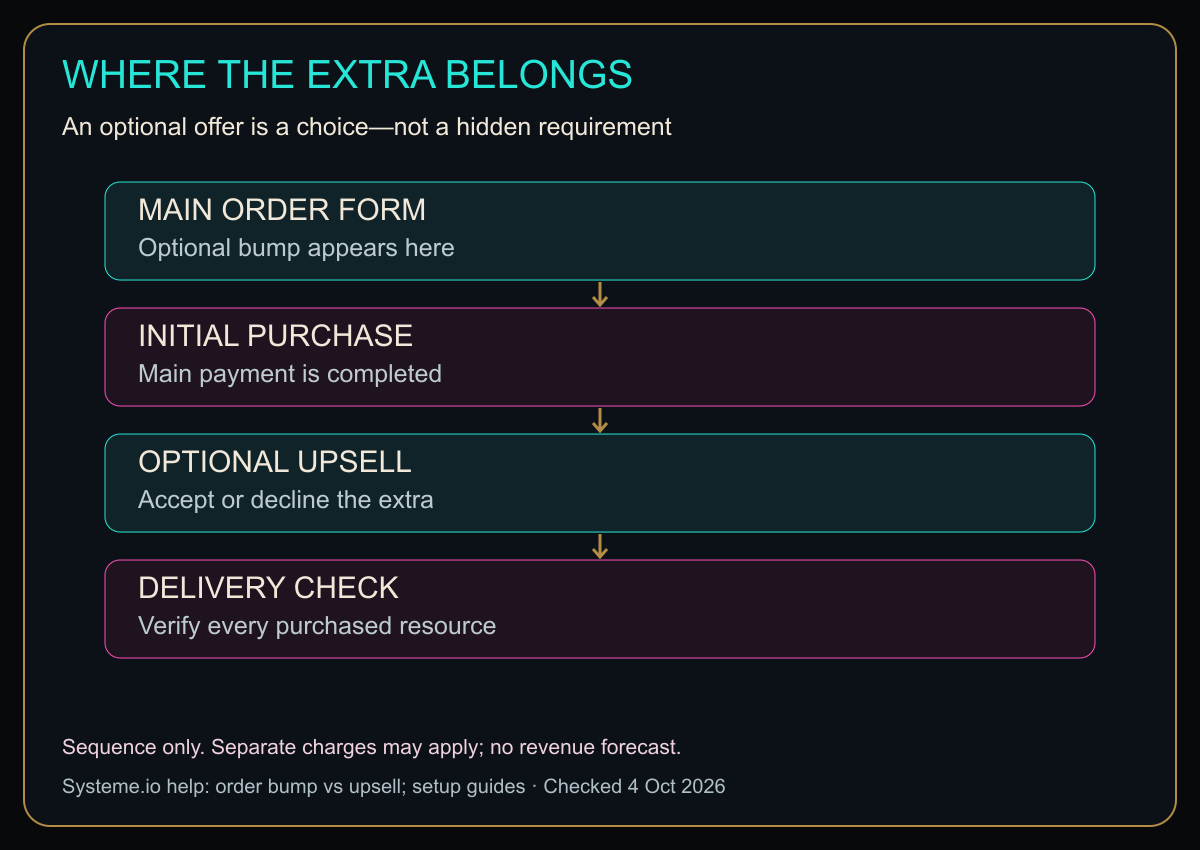
Diagram in words: MAIN ORDER FORM: Optional bump appears here. INITIAL PURCHASE: Main payment is completed. OPTIONAL UPSELL: Accept or decline the extra. DELIVERY CHECK: Verify every purchased resource. Sequence only. Separate charges may apply; no revenue forecast.
Original HBH process diagram, based on the official distinction and setup guides above. Sequence only; it does not predict conversion, revenue or transaction totals.
The payment detail worth checking twice
The bump help page warns that a processor window may show only the main offer’s price even though the bump is also charged separately. Do not promise buyers one combined bank charge based on what the page looks like. Inspect the actual transaction records and customer messages for your connected processor. Payment caveat.
That is also why screenshots of a pretty checkout are not enough for launch approval. You need a small acceptance checklist:
- Main purchase only: Does the buyer receive exactly the main product, with no extra charge or bonus access?
- Main purchase plus bump: Are the optional choice, amount and additional fulfillment all correct?
- Upsell accepted: Is the extra charge explained and the upgrade actually delivered?
- Upsell declined: Can the buyer still reach the original purchase and its instructions?
- Mobile reading: Can a person see the price, recurrence terms and both choices without decoding a cramped wall of text?
These are suggested checks, not a report that HBH executed purchases. Any live payment test needs your authorization and may carry processor fees. Do not assume a later refund makes testing cost-free.
Measure the whole outcome, not just the shiny bigger order
If you test an optional offer, keep a simple record of completed main purchases, extra-offer acceptances, refunds and customer-support questions. Compare like-for-like periods and note traffic changes. A handful of orders is a weak basis for declaring a winner.
Do not confuse revenue with profit. Extra fulfillment work, refunds and payment costs still exist even if a funnel dashboard is feeling very optimistic. The best extra is one that customers understand, receive and find useful—not merely one they clicked.
For a brand-new offer, my editorial recommendation is to launch the cleanest main purchase first. Add one relevant extra only after its delivery path is dependable. That makes problems easier to isolate and keeps the buyer’s decision manageable.
Is Systeme.io the right place to do this?
It is worth considering when you want the offer page and digital-resource delivery organized in the same platform. It is not a substitute for creating the product, clarifying refund terms or making sure the extra has value. Check current plan limits and payment compatibility for your own setup before paying for a plan.
Explore Systeme.io through HBH’s affiliate link
If funnels themselves still feel like marketing alphabet soup, start with HBH’s plain-English sales-funnel guide.
Can I use both a bump and an upsell?
They occupy different points in the journey, but using both is not the goal. Start with the one that solves a genuine buyer problem and verify the complete purchase path before adding complexity.
Does an upsell guarantee a larger profit?
No. Offer acceptance, costs, refunds and customer experience determine the result. This guide does not provide tested conversion rates or earnings forecasts.
What should I fix first if customers are confused?
Make the base purchase, each optional charge and the delivery instructions unmistakable. The customer should not need a flowchart to understand their bill—even if the business owner wisely uses one behind the scenes.
Sell a useful next step, not an escape-room puzzle. If the extra needs an apology after checkout, it needed a better explanation before it.
Sources and checks
- Systeme.io: order bump versus upsell, updated December 31, 2025.
- Systeme.io: order-bump setup and payment caveat, updated August 27, 2026.
- Systeme.io: upsell/downsell setup and transaction behavior, updated August 27, 2026.
All sources checked October 4, 2026. Interfaces and terms can change; confirm your live account settings before launching.
Honey, Be Honest: Checkout Is Not a Haunted House
I do not want a buyer clicking “pay” and immediately wondering what just happened to their wallet. A bump should feel like, “Want fries with that?” An upsell should feel like, “Since you bought this, here is the next useful thing.” Neither one should feel like a trapdoor.
The nerdy part is the sequence. The human part is trust. If I need a flowchart to explain why somebody got charged, the funnel has already become too impressed with itself.
The Honey Be Honest Bottom Line
I want the useful part without the feature-list Olympics. If something solves the actual job cleanly, it earns its place. If it needs three workarounds and a pep talk, I’m counting that against it.


Leave a comment