
VERDICT: In HighLevel, a contact is the person or business record; an opportunity is the deal moving through a pipeline. I do not create an opportunity just because somebody exists in the CRM. That is how a contact list quietly starts pretending it is revenue.
Here’s the quick comparison before I get into the weeds.
Quick Comparison
| Thing | What It Represents | My Sanity Check |
|---|---|---|
| Contact | The person or business record | One human can exist without an active deal |
| Opportunity | A potential deal or sales process | Create it when there is an actual opportunity to track |
| Pipeline stage | Where that opportunity is in the process | Stages should describe deal progress, not random contact facts |
VERDICT
I keep the nouns separate: contact = person, opportunity = deal, pipeline = process, stage = current position. If every contact becomes an opportunity, the dashboard starts confusing “I know this person exists” with “this sale is real.”
A contact is the person. An opportunity is a potential deal associated with that person. A pipeline is the process, and a stage tells you where the deal currently sits. Keep those ideas separate and the CRM becomes a working system instead of an expensive collection of hopeful names.
Your newsletter subscriber, current client and potential new project may involve the same person, but they are not all the same business fact. Counting every contact as a sale is optimism wearing a dashboard costume.
Affiliate disclosure: I may earn a commission at no extra cost to you through the HighLevel affiliate link below. No CRM setup guarantees closed deals or income.
How I checked this: I reviewed HighLevel’s official pipeline, opportunity and filtering documentation on October 4, 2026. The sample process is hypothetical and the recommendations are editorial, not a report of Honey’s sales performance or personal software use.
Conceptual HBH artwork—not customer data, a real contract or a platform screenshot.
Learn the four nouns before building the board
HighLevel’s introductory guide distinguishes contacts, opportunities, pipelines and stages, and allows opportunities to be added manually, imported or created through automation. You do not need a workflow just to begin tracking a few genuine deals. Getting-started guide.
Term: Contact
What it represents: The person associated with the record
Hypothetical example: Morgan, a business owner
Term: Opportunity
What it represents: A particular potential sale
Hypothetical example: Morgan’s website-refresh project
Term: Pipeline
What it represents: The process used to handle that sale
Hypothetical example: Website-services sales process
Term: Stage
What it represents: A step within that process
Hypothetical example: Proposal sent
The example is intentionally ordinary. A useful CRM does not need mystical terminology. It needs people to agree on what happened and what should happen next.
Set an entry rule for opportunities
Decide what qualifies as a deal worth tracking. A direct request for a quote might qualify immediately. A casual content download may belong in the contact database without a sales opportunity yet. Your rule will depend on how the business actually sells.
Write the rule in a sentence the team can apply consistently. Then sample a handful of records and ask whether they meet it. If every answer requires a debate, clarify the rule before automating opportunity creation.
This is an editorial operating recommendation, not a platform requirement. Its purpose is to keep the pipeline useful. A board stuffed with people who never asked about buying can hide the few people waiting for a real response.
Give each stage an exit condition
HighLevel’s pipeline guide describes stages as steps in a sales or service process and supports editing their names and order. The sensible starting point is your real process—not a long template you feel obliged to fill. Understanding pipelines.
For a hypothetical service business, your stage definitions might look like this:
- New inquiry: A request has arrived; a team member must review it.
- Needs understood: The business has enough information to decide whether to prepare an offer.
- Proposal sent: An actual proposal has gone to the prospective buyer.
- Decision pending: The agreed decision date or next conversation is recorded.
These are sample definitions, not HighLevel defaults or universal best practices. Keep a separate, meaningful outcome for a deal that was won, lost or abandoned. “I sent a proposal” is progress; it is not money in the bank.
A stage and a status are not the same thing
HighLevel’s filtering guide distinguishes stage movement from lifecycle status, with statuses including Open, Won, Lost and Abandoned. It also notes that a pipeline view may default to showing only open opportunities. Before deciding a deal vanished, inspect the active filters. Opportunity filters.
Do not create a new duplicate opportunity merely because you cannot see the original in the current view. Search deliberately using the correct pipeline and status first. A filter problem should not become a data problem.
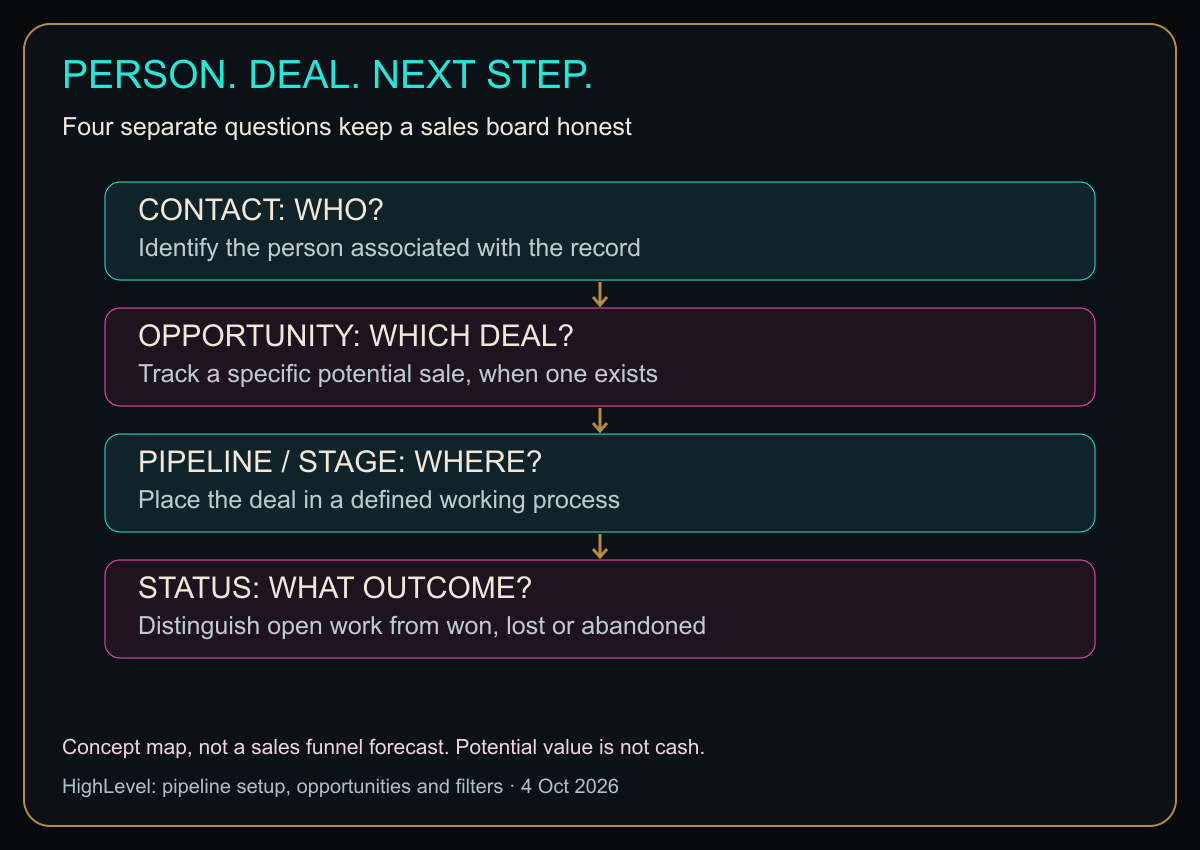
Open the diagram at full size for larger labels.
Original HBH conceptual map based on the official definitions. It does not imply every contact has a deal or that pipeline value is collected revenue.
Keep value and revenue separate
Opportunity records can hold a deal value, but a prospective value is not proof of a paid invoice. HighLevel describes opportunities as potential sales or deals in a pipeline. Opportunity overview.
Label your own reports carefully: open potential value, won deals, invoiced amount and collected cash are different measures. Do not add speculative pipeline value to actual sales and call it monthly income.
If you forecast, document the assumptions separately. A colored column does not establish the probability of a purchase, and this article supplies no made-up conversion percentages to make the board feel scientific.
Start manually, then automate the stable parts
Create a small set of real opportunities, assign owners and record concrete next actions. Review whether the team can maintain them without confusion. Only then consider which repeated event deserves automatic creation or movement.
For any automation, define what record it should update and how you will avoid creating another deal for the same event. A person may legitimately have more than one project; that does not mean every form submission should create another copy of the same one.
Test with controlled records and inspect the saved pipeline, stage and status. The article’s purpose is the underlying data model, not a claim that I configured or validated a workflow in your account.
A weekly cleanup that is actually useful
Review stalled open deals and ask: is the owner clear, is the next action real, and is the expected decision still current? Close out records according to an agreed policy instead of keeping them open forever to make the total look impressive.
When you change stage definitions, tell the team and check existing automations before moving records in bulk. A renamed column may affect how people interpret reports even when no sale has changed.
Explore HighLevel through my affiliate link
Read my HighLevel small-business review if you are deciding whether this broader platform fits your business rather than just learning its vocabulary.
Track the person, the deal and the next action honestly. The pipeline should tell you where work is needed—not flatter you about how much money might someday arrive.
Diagram in plain text
- CONTACT: WHO?: Identify the person associated with the record
- OPPORTUNITY: WHICH DEAL?: Track a specific potential sale, when one exists
- PIPELINE / STAGE: WHERE?: Place the deal in a defined working process
- STATUS: WHAT OUTCOME?: Distinguish open work from won, lost or abandoned
Concept map, not a sales funnel forecast. Potential value is not cash.
Sources
- Pipelines and opportunities setup.
- Pipeline structure.
- Opportunity filters and statuses.
- What an opportunity represents.
Checked October 4, 2026. Examples are editorial illustrations, not measured sales results.
The comparison that keeps the settings straight
| Thing | What it controls | My sanity check |
|---|---|---|
| Contact | The person or organization record | I keep identity facts here. |
| Opportunity | A specific potential deal | I create it only when a real sales process exists. |
| Pipeline | The sequence a deal moves through | I keep it short enough that every stage has a meaning. |
| Stage | Where the opportunity is right now | I define what moves a deal in and out. |
Honey, Be Honest: Why I Went Looking
I went looking because CRM dashboards can make a pile of names look financially impressive with very little effort. A thousand contacts is not a thousand deals any more than a thousand phone numbers means I have a thousand friends. The software behaves much better once I stop making every noun carry the same job.


Leave a Reply