
VERDICT: I use Round Robin when one eligible person should take the appointment. I use Collective when several specific people must attend together. The calendar type should follow the meeting requirement, not whichever menu name sounds more impressive.
VERDICT
Choose a Round Robin calendar when one eligible team member should handle an appointment. Choose a Collective calendar when multiple required hosts need to attend the same appointment together. The question is not how many people work for you. It is how many of them must be present for this particular booking.
That decision comes before color-coding the calendar or decorating the booking page. A lovely page that books the wrong people is a beautifully wrapped scheduling problem.
Affiliate disclosure: my HighLevel link is an affiliate link. A qualifying purchase may earn HBH a commission at no extra cost to you. I do not promise more bookings or equal income for team members.
How I checked this: I checked HighLevel’s official Round Robin and Collective calendar documentation on October 4, 2026. This is a documentation-based buying and configuration guide, not a claim of hands-on results in Honey’s account.
Conceptual editorial illustration, not a screenshot, actual staff roster or availability display.
Begin with a sentence, not a calendar menu
Try one of these: “Any qualified consultant can handle this introduction,” or “The consultant and project lead must both attend the planning meeting.” If the team cannot agree on the sentence, resolve that first. Software cannot cleanly implement two incompatible staffing assumptions.
A solo operator should also question whether a team-distribution setup is necessary. Pick the simplest supported calendar that matches the job instead of buying administrative work you do not need.
Meeting need: One of several eligible people can help
Likely fit: Round Robin
Question to settle before setup: Which staff are eligible and how should bookings be distributed?
Meeting need: Two or more required hosts attend together
Likely fit: Collective
Question to settle before setup: Whose availability must overlap?
Meeting need: A customer deliberately chooses one specialist
Likely fit: A supported named-host booking path
Question to settle before setup: Should that choice override general distribution?
Meeting need: Many customers join the same session
Likely fit: A separate group/class-style requirement
Question to settle before setup: What capacity and attendee behavior are needed?
The last row matters: a calendar with several hosts is not automatically a class calendar with several customer seats.
What Round Robin actually solves
HighLevel’s Round Robin guidance describes routing an appointment to an eligible team member. Setup includes the participating staff and their availability. This is a one-host-per-booking staffing pattern, not an instruction for everyone on the calendar to attend. Create a Round Robin calendar.
The practical advantage is substitutability. If the service genuinely can be delivered by any qualified host, you do not need every person free at once. But the eligibility list must be honest: adding someone who cannot perform the service merely inflates apparent capacity.
Decide what happens when an assigned host is absent, leaves the team or loses the required qualification. Keep ownership of existing appointments separate from who may receive future bookings. Do not assume editing a staff list safely reorganizes every old commitment.
Availability and equal distribution are different priorities
HighLevel documents modes that favor availability or equal distribution. The equal-distribution calculation applies to the “Any Available” path and uses monthly counts; a visitor choosing a particular staff member can bypass that distribution logic. The documented count-reset behavior also means changes to staff or mode can affect the rotation. Round Robin distribution modes.
That is why “Round Robin means every other appointment goes to me” is too simple. Before promising fairness, define what fairness means: appointment count, hours worked, appointment length or another measure. The platform’s documented booking-count behavior is not a guarantee of equal workload or earnings.
If one team member offers many more hours than another, a distribution decision has a business tradeoff. Decide it openly, then check actual assignments against the chosen policy. Do not silently change scheduling rules to settle a staffing disagreement.
What Collective actually solves
Collective calendars are for appointments requiring the selected team members together. HighLevel’s overview describes using their shared availability, with a primary owner and team notifications. The creation guide specifies at least two team members and explains the primary owner’s role in the meeting setup. Collective overview, creation guide.
This makes sense for a consultation that truly requires two disciplines or a handoff requiring both the outgoing and incoming lead. It does not make sense merely because a manager likes being copied on everything. Notification and mandatory attendance are different needs.
As more required people are added, finding shared time can become harder. That is a consequence of the meeting design, not automatically a software defect. If a booking page offers too few slots, confirm whether every listed host is actually necessary before weakening legitimate availability protections.
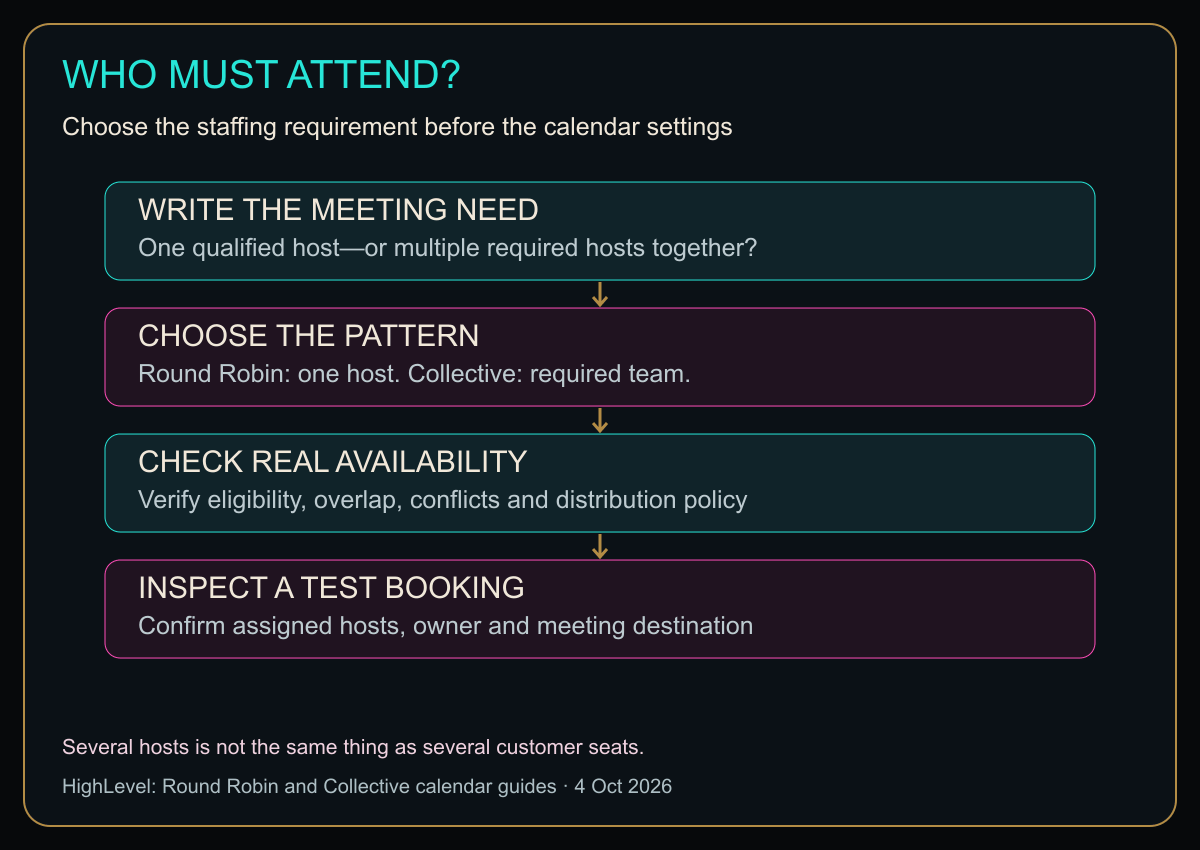
Open the diagram at full size for larger labels.
Original HBH decision map based on the cited guides. No real staff availability or booking performance is shown.
A small example beats a giant settings debate
Imagine a fictional design studio with two people who can each conduct an introductory call. Round Robin is a sensible candidate because either can do the work alone. Their project kickoff, however, requires the chosen designer and the production lead together; that is a Collective-style requirement.
Do not copy that example blindly. If the introductory call requires a particular specialist, the interchangeable-host assumption no longer holds. Write the actual service requirement and let it determine the calendar choice.
Keep meeting location explicit, too. “The calendar assigned someone” does not establish that the right room, call link or address reached the right participants.
Check the result with a controlled booking
Before opening the link to customers, use an authorized test record and let participating staff know. Verify:
- The booking page represents the correct service and expected duration.
- Required availability and conflicts are respected.
- Round Robin assigns the intended number of hosts under the selected path.
- Collective includes every required host and the correct primary owner.
- Saved appointment, notifications and meeting destination agree.
- Cancellation or rescheduling reaches the appropriate people.
Those are acceptance checks to perform, not results HBH has already observed. Clean up only your own test booking. Avoid testing with a customer’s identity or opening someone’s private calendar details unnecessarily.
Who should consider HighLevel here?
It is a relevant option when scheduling is part of an existing customer-management process. Compare ongoing administration and your actual needs before adopting it solely for one simple calendar link.
Explore HighLevel through my affiliate link
My broader HighLevel review and plan comparison cover a different decision: whether the wider platform fits your business.
One qualified host or all required hosts? Answer that clearly, then let the calendar do the job you actually assigned it.
Diagram in plain text
- WRITE THE MEETING NEED: One qualified host—or multiple required hosts together?
- CHOOSE THE PATTERN: Round Robin: one host. Collective: required team.
- CHECK REAL AVAILABILITY: Verify eligibility, overlap, conflicts and distribution policy
- INSPECT A TEST BOOKING: Confirm assigned hosts, owner and meeting destination
Several hosts is not the same thing as several customer seats.
Sources
- Round Robin calendar creation, updated March 16, 2026.
- Round Robin distribution modes, updated April 14, 2026.
- Collective calendar overview, updated September 30, 2025.
- Creating Collective calendars, updated March 10, 2026.
Checked October 4, 2026. Verify current options for your account and calendar type before launch.
The comparison that keeps the settings straight
Here’s the quick comparison before I get into the weeds.
Quick Comparison
| Thing | What it controls | My sanity check |
|---|---|---|
| Round Robin | Chooses one eligible host | I use it when any qualified person can take the meeting. |
| Collective | Requires multiple hosts together | I use it only when all required people truly need to attend. |
| Availability priority | Who can actually take the slot | I test a real date rather than assuming the calendar understood me. |
| Distribution settings | How bookings are spread | I separate fairness goals from simple availability. |
Honey, Be Honest: Why I Went Looking
I went looking because scheduling software loves making simple human questions sound like graduate-level math. Do I need one person or all the people? That is the decision. Everything after that is just the software making me prove I meant it.


Leave a Reply