
Five spiders you may meet around lake properties, boathouses, and barns, plus three useful little weirdos and a practical look at Spiders No More Systems.
A very important HBH disclosure:
I do not get a commission, referral fee, kickback, free product, or payment of any kind from Spiders No More Systems. I just believe in what they do, and I wanted to tell you about them. This is an editorial company spotlight, not a paid endorsement.
I do not hate nature. I hate nature putting a fucking tripwire between my forehead and my coffee.
There is a difference. I can appreciate a lake, a beautiful horse, a wooded property, and a sunset that makes me briefly forget my responsibilities. What I cannot appreciate is a spider dangling from the boathouse like it paid for the lumber. I packed sunscreen. I did not pack the emotional resources to negotiate dock access with something that has eight knees.
And before someone starts with “they were here first,” I know. So was dirt. I still do not want it in my bed.

For this particular discussion, we are looking at the lake-country territory served by Spiders No More Systems, including the Lake Livingston, Lake Conroe, Lake Nacogdoches, and Lake Houston areas. These are five spiders associated with the kinds of shoreline, woodland, garden, and sheltered-building habitats found there, not a claim that every property has all five or that they are equally common. [1] [2] [3] [5]
One inconvenient fact before we start screaming: spiders eat other small creatures and play a useful role in their surroundings. “Uninvited” describes their location in my personal space, not their moral character. We can set boundaries without pretending every spider is a tiny serial killer. [4]
1. Dark fishing spiders: absolutely not the dock manager
Dolomedes tenebrosus
.jpg)
Photo: Katja Schulz, Dark Fishing Spider, CC BY 2.0. Image unchanged; displayed at a reduced size.
This is the spider that looks large enough to have an opinion about your boat insurance. The name “fishing spider” already feels presumptuous. Sir, where is your license? Who invited you? Why are your legs arranged like you are about to explain the marina rules to me?
Dark fishing spiders are mottled brown and black, often with banded legs and dark W-shaped markings on the abdomen. They occur around vegetation and rocks near permanent water, but also in drier woods and around logs. A wooded lake property is therefore a plausible place to encounter one; the name does not mean it lives exclusively on docks. [2]
These are hunters of insects and other small arthropods. Their size can be alarming, but size alone does not tell you how hazardous a spider is. [2] [4]
My preferred arrangement is simple: you hunt over there, I drink coffee over here, and neither of us introduces ourselves by touching the other. That is not hostility. That is an excellent neighbor agreement.
2. Wolf spiders: the all-terrain nope
Family Lycosidae

Photo: Cor2ran, Carolina wolf spider, crop, CC0 1.0. Image unchanged; displayed at a reduced size.
A wolf spider does not need a dramatic entrance. It simply runs across the ground with the confidence of somebody who knows you are about to lose your shit.
Usually brown, somewhat hairy, and quick, wolf spiders hunt rather than waiting in prey-catching webs. They occupy ground-level habitats such as fields, gardens, and woods. Their speed is startling, but they are not aggressive. [3]
Around a rural property, that means the ground deserves some attention before you sit down and announce how peaceful everything is. I am not saying every barn contains a wolf spider. I am saying “look before putting your bare hand somewhere you cannot see” is a lifestyle choice I support.
This is also where Queeny and I would approach the problem differently. In my head, she is calmly assessing the situation while I am considering whether the entire weekend can be written off as a loss. Her hair is in a tidy dark bun. Mine has become a distress signal. Neither of us has volunteered to pick up the spider.
3. Black widows: this is not the time to audition for bravery
Latrodectus species, including the southern black widow, L. mactans

Photo: NASA, Latrodectus mactans, Public domain. Image unchanged; displayed at a reduced size.
Here is where the jokes get a little farther away from the actual spider.
Adult female black widows are typically shiny black with an hourglass marking underneath the abdomen. They favor protected, relatively undisturbed spots and irregular webs. Storage areas and sheltered recesses deserve a look before you reach into them. Color alone is not a dependable identification method, and you do not need to flip a spider over to investigate. [4]
A black widow bite can cause significant illness and warrants prompt medical advice. That is not the same as “see one and assume somebody is about to die.” Take the risk seriously without turning the spider into a horror-movie prophecy. [4]
Do not grab it, poke it, or make the least sensible person in the group demonstrate that they are “good with animals.” A suspicious widow near regularly used equipment is a job for someone qualified to identify and manage it, not Cousin Confidence and a flip-flop.
4. Brown widows: beige is not a safety rating
Latrodectus geometricus

Photo: LFrImagery, Latrodectus geometricus, CC BY-SA 3.0. Image unchanged; displayed at a reduced size.
Apparently, the widow family also comes in a neutral palette. Fantastic. A spider that coordinates with the patio furniture. Exactly what the vacation rental needed.
Brown widows are documented in Texas. Females often have mottled tan and brown coloring, banded legs, and an orange-toned hourglass underneath. Their spiky egg sacs are a useful clue, although young black widows can look similar. Favorite protected spots include the undersides of outdoor furniture, railings, pots, and other sheltered places around buildings. [5]
That patio chair you were about to confidently rearrange? Check underneath before putting your fingers there. Not because every chair is occupied, but because finding out with your hand is a piss-poor inspection method.
Reported brown widow bites are generally less severe than black widow bites, but serious reactions have occurred. “Usually less severe” does not translate to “go ahead and handle it.” [5]
My color scheme may be neutral. My response will not be.
5. Yellow garden spiders: beautiful work, terrible fucking placement
Argiope aurantia

Photo: Radtek67, Argiope aurantia, Public domain dedication. Image unchanged; displayed at a reduced size.
I will give credit where it is due. The yellow garden spider has committed to a look. Black and yellow, dramatic proportions, an entire custom-built installation. Some of us cannot finish hanging one curtain, and this bitch has completed outdoor architecture.
These orb-weavers build large webs in gardens and tall vegetation, catching insects. Their striking appearance does not make them dangerous to people; they are shy spiders best left alone when their webs are out of the way. [3]
And there it is: out of the way. In the landscaping beside a stable? We can probably reach an understanding. Directly across the space my face needs to occupy? The zoning discussion has reopened.
This one is already a beneficial spider. So are several others above. The dividing line is not “good spiders versus evil spiders.” It is “useful neighbor versus poorly located roommate.” I reserve the right to respect the craftsmanship while declining to wear it.
Three more eight-legged friends I am trying very hard to be mature about
I said I hate spiders. I did not say I cannot recognize somebody doing honest work. We are calling this growth, and I would appreciate absolutely no surprise demonstrations.
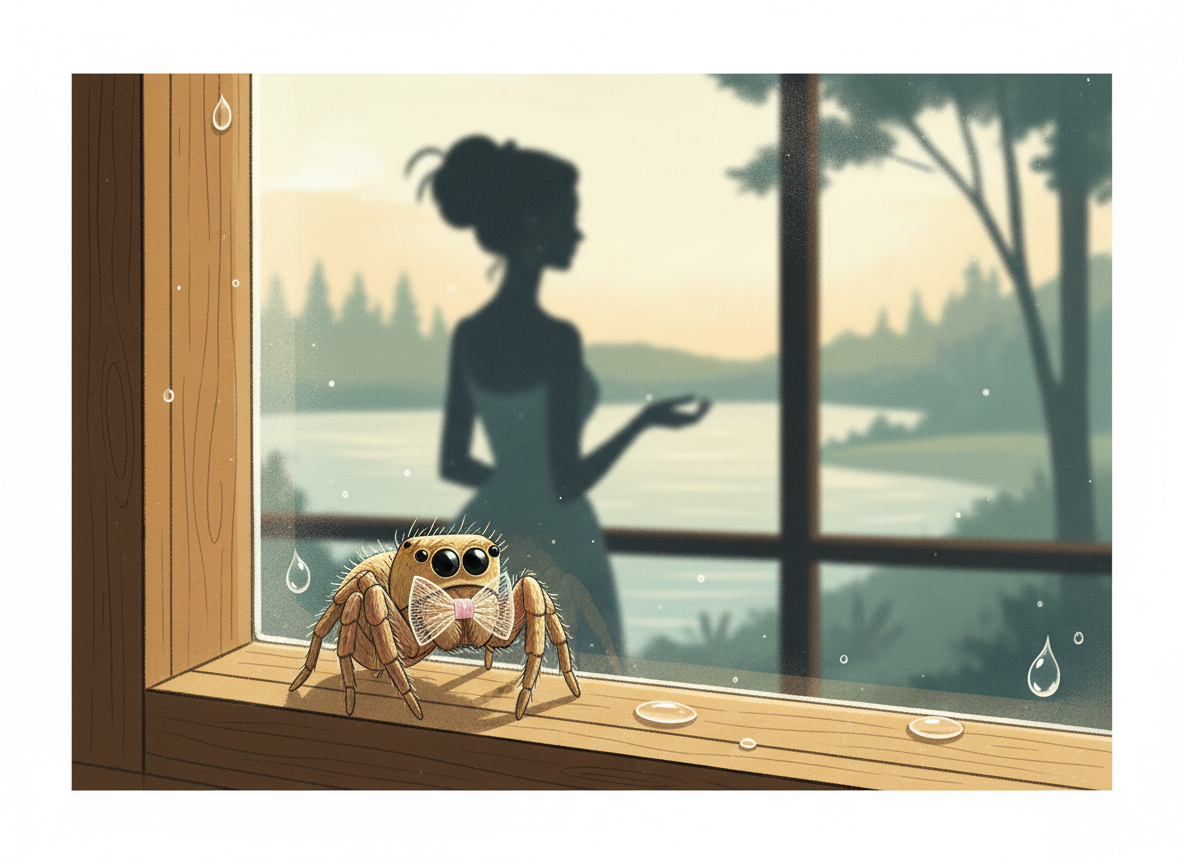
6. Jumping spiders: unfortunately, the eyes are working on me
Family Salticidae; pictured: Phidippus audax

Photo: Bruce Marlin, Phidippus audax, CC BY-SA 2.5. Image unchanged; displayed at a reduced size.
Jumping spiders are compact daytime hunters with prominent eyes; they can turn up on sunny walls and windows. Rather than relying on a prey-catching web, they leap onto their food. [3]
They also have the audacity to look curious. That is manipulative branding. A little fuzzy face does not erase the leg count, but I admit it complicates my position.
A jumper outside, away from where people are handling things, is the kind of neighbor I can reluctantly support. It can have the windowsill on the outside. I get the inside. We do not need matching friendship bracelets.
7. Cellar spiders: eight pipe cleaners and a quiet little business
Family Pholcidae; pictured: Pholcus phalangioides

Photo: Daniel Ullrich (Threedots), Pholcus phalangioides, CC BY-SA 3.0. Image unchanged; displayed at a reduced size.
Cellar spiders have delicate, very long legs and build loose webs in quiet corners. The long-bodied cellar spider occurs throughout the United States. They are true spiders, unlike the harvestmen that also get called daddy longlegs. [3] [6]
And no, the story that they are the world’s deadliest spider but cannot bite you is not supported by scientific evidence. Please retire that tale alongside the chain email that promised you money for forwarding it. [6]
As web-building predators, they catch small prey. A tucked-away corner is a different conversation from a spider hanging over the guest pillow. [6]
Personally, I would prefer that the vacancy in my ceiling remain a vacancy. But a little perspective is useful: noticing a cellar spider is not the same situation as finding a widow in a spot someone regularly reaches into.
8. Orchard orb-weavers: tiny jewelry with questionable boundaries
Leucauge species; pictured: Leucauge venusta

Photo: Patrick Edwin Moran, Leucauge venusta, CC BY-SA 3.0. Image unchanged; displayed at a reduced size.
Orchard orb-weavers are small spiders with slender greenish legs and silvery markings. Their webs are often horizontal or tilted, and they occur around shrubs, woodland edges, and wooded yards. They catch small insects, including flies and mosquitoes. [7]
So yes, a little woodland glimmer may actually be a spider doing useful work. Nature has put the pest-control department in metallic accessories.
This is a good candidate for leaving alone when it is tucked into vegetation rather than occupying a doorway. It can sparkle in the shrubbery. I can appreciate it from a distance that does not require bravery, a zoom lens, or subsequent counseling.
So what can we do about their Fuckery?
After all, it is their planet also. That is absolutely not their boathouse. They absolutely do not own those horses in the stables. And they cannot vacation with me.
We are not negotiating the existence of spiders. We are negotiating access to the places where people sleep, sit, work, and attempt to enjoy themselves without inventing new swear words.
Start with unglamorous boundaries: repair damaged screens, close gaps, reduce clutter, remove nuisance webs from frequently used areas, and cut back unnecessary outdoor lighting that attracts insects. A spider in a garden is a different management decision from one in a guest room. [3] [4]
For owners, a sensible turnover routine should include looking around doors, furniture, storage spaces, and other guest-use areas. For renters, report a suspected widow or recurring problem to the host rather than spraying somebody else’s property. “I mixed some stuff I found under the sink” is not a vacation amenity.

Spiders No More Systems: custom planning, plus someone to maintain the damn thing
This is where Spiders No More Systems comes into the conversation. Its website describes automated misting systems with adjustable intervals for homes, boathouses, barns, and businesses, along with customized installation plans. It also lists refills, routine maintenance, troubleshooting, and repairs for existing spider or mosquito systems. [1]
That distinction matters. “Custom” should mean a plan suited to the property, not a generic setup waved vaguely in the direction of the problem. A boathouse, a horse barn, and a vacation-home patio are different spaces. Ask how the proposed design accounts for yours. The website supports customized planning; it does not establish that every component is individually manufactured from scratch.
And maintenance is part of the conversation from the beginning. Ask what is checked, what is included, when service happens, how refills work, and what to do if something leaks or stops working. Buying a system and forgetting it exists is not the same thing as keeping it maintained. Queeny would appreciate a clear service agreement. I would appreciate fewer unexpected roommates. These goals are compatible.
The company lists service in Coldspring, Colmesneil, Conroe, Crockett, Huntsville, Livingston, Montgomery, Nacogdoches, Onalaska, Point Blank, Spring, and Trinity, plus surrounding areas. Confirm your particular address and property type directly. [1]
Visit Spiders No More Systems or call (936) 642-3232 to discuss a property-specific plan and maintenance options. [1]
One very important grown-up paragraph before anybody starts misting
Ask for the exact pesticide label and confirmation that its use is permitted in your specific setting. EPA cautions that no pesticide is entirely risk-free, some common misting ingredients can harm beneficial insects, and permethrin is highly toxic to fish. That is general safety information, not a claim about which product SNMS uses. EPA’s residential-misting guidance explicitly excludes livestock barns and boat docks; it is not approval for spraying those settings. Get site-specific instructions for horses, feed, water, guests, and pets, and keep a system maintained. The same EPA guidance notes limited effectiveness research for residential misting systems. No honest discussion should promise a permanently spider-free property. [8]
Translation: fewer surprises, thoughtful placement, the right product for the actual location, and a service plan you understand. Not a chemical free-for-all because something rude built a web in your sunglasses.
Let the garden spiders handle garden business. Let a qualified professional assess recurring problems in the places you actually use. And let me sit by the lake without a creature with eight legs acting like it put down the deposit.
They can have their place in the ecosystem. They cannot have my reservation.
Love, Honey
About this post: This is an informational company spotlight, not an independently tested review of an SNMS installation. Service descriptions come from the company website. Photographs are reference images, not evidence of spiders at an SNMS customer property. Appearance varies, and these examples are not a substitute for expert identification.

Sources and further reading
- Spiders No More Systems: installations, maintenance, and service area
- Missouri Department of Conservation: Dark Fishing Spider
- University of Minnesota Extension: Spiders
- University of California IPM: Spiders
- UC Riverside: Brown Widow Spider
- UC Riverside Spider Research: Daddy Long Legs
- University of Florida IFAS: Orchard Orbweaver, Orchard Spider
- US EPA: Mosquito Misting Systems


Leave a comment