The Verdict
For most home cooks who want to set the temperature on the machine itself, Anova Precision Cooker 3.0 is my Amazing pick. Breville Joule Turbo is Good for someone who wants guided app cooking and is comfortable relying on that app. INKBIRD ISV-100W is Mid for a reader prioritizing polished guidance, but its onboard controls and straightforward cooking role may be exactly enough.
These are editorial judgments based on manufacturer sources and exact Amazon listings checked September 20, 2026. I have not cooked a steak with each machine and conducted a blind tasting in a dramatic black apron. Sous vide already sounds fancy. It does not need imaginary evidence wearing a chef hat.
The Comparison
| Exact model | HBH fit | Practical difference |
|---|---|---|
| Anova Precision Cooker 3.0 (paid link) | Amazing: direct control | On-device time and temperature; app optional |
| Breville Joule Turbo BSV600PSS (paid link) | Good: guided cooking | Breville+ app-centered setup and programs |
| INKBIRD ISV-100W (paid link) | Mid: premium guidance | Local controls and 2.4 GHz Wi-Fi |
Decide who is in charge: you or your phone
A sous-vide immersion circulator heats and circulates a water bath. Food goes in a suitable sealed bag or another container appropriate to the method. The appliance controls the bath; it does not brown a steak, prepare a sauce, or wash the pan you use afterward. If the promise in your head is “push one button and get an entire restaurant dinner,” let us gently remove the imaginary waiter.
The three exact models here are Anova Precision Cooker 3.0, Breville Joule Turbo BSV600PSS, and INKBIRD ISV-100W. We are not substituting Anova's Mini or an old Bluetooth Nano, original Joule, or INKBIRD ISV-200W. Similar-looking sticks can have different controls, power, connectivity, and software requirements.
The most useful difference is what happens when you do not want your phone involved. Anova 3.0 offers time and temperature controls on its display. INKBIRD also offers local controls. Joule Turbo is built around the Breville+ guided-app experience. If the phone is frequently missing, flat, or being used by a child to photograph the ceiling, that deserves a place in the buying decision.
Amazing: Anova Precision Cooker 3.0 for direct control
Anova lists a two-line touch display, an adjustable detachable clamp, a removable skirt, and 1,100 watts for the model discussed here. The screen lets you see time and temperature together and operate the cook directly. Its dual-band Wi-Fi is a separate convenience rather than the only way to start dinner.
My reason to favor it is that straightforward division of responsibility. The appliance can do the heating job while the app remains optional for a person who prefers local operation. That feels practical for a household where one person likes connected features and another person considers a firmware update a personal insult.
The trade-off is that you are buying more than a bare-bones circulator. Decide whether the clamp, interface, and connected options justify the actual price gap you see. A more expensive stick does not rescue the wrong cooking time for a very thick piece of food. Technique remains on the payroll.
Anova's current app information says the devices can be used without a subscription, with free features and an optional Premium plan. Older discussions describe different subscription rules, so do not copy an old complaint into a current buying decision. The safest enduring distinction is the one visible on this machine: the Precision Cooker 3.0 has manual controls. Confirm the current app plan if a particular remote feature is essential to you.
Good: Joule Turbo for guided cooking
Breville Joule Turbo uses the Breville+ app for its guided experience. Breville describes Turbo programs that can shorten supported cooking workflows using inputs such as food thickness and weight. That is not a promise to cut every recipe in half, and the amount of information you provide matters. A machine cannot calculate around a steak you described optimistically.
I would shortlist Joule Turbo for a cook who wants guidance and is happy to follow a supported program closely. The app-centered design is the attraction, not an inconvenience to conceal. Someone who enjoys visual doneness guidance and progress notifications may find that more useful than a row of numbers on the appliance.
The compromise is dependence on the phone-and-app workflow. Check phone compatibility and the current setup instructions before purchase. Breville's current support identifies Joule Turbo by its orange top ring and model BSV600, distinguishing it from the original stainless-top and white-top Joule models. An older secondhand listing should not be treated as the Turbo simply because the seller wrote “Joule.”
I would choose it when guided cooking is the reason for buying sous vide in the first place. I would pass when the buyer specifically wants an appliance they can set entirely from its own controls. That is not being difficult. It is remembering what we asked the shopping cart to solve.
Mid: INKBIRD ISV-100W for an uncomplicated starting point
INKBIRD documents 1,000 watts, local temperature-and-time controls, Wi-Fi operation, and a low-water response. The Wi-Fi requirement is 2.4 GHz for this model. The manufacturer's page and manual should be used for setup; do not transfer instructions from a newer INKBIRD model with a similar name.
The sensible reason to choose it is that you want the water-bath method without making premium guided recipes the central feature. You can start with a reliable recipe, operate the device locally, and decide later whether the app helps. There is something refreshing about a kitchen purchase that does not insist on becoming your lifestyle coach.
The Mid label reflects this guide's preference for Anova's interface or Joule's guided ecosystem. I have not measured temperature stability or heating speed on these three units, so there is no evidence here that the INKBIRD cooks worse. Treat claims about silence, perfect results, and speed as manufacturer language rather than conclusions from our own kitchen.
Before buying, check the exact U.S. version, available room on the pot, and minimum and maximum water markings in the manual. The linked listing is ISV-100W; the “100W” in its model name should not be mistaken for its 1,000-watt heater rating. Product naming enjoys keeping us humble.
The Chart
The chart: control freaks, assemble
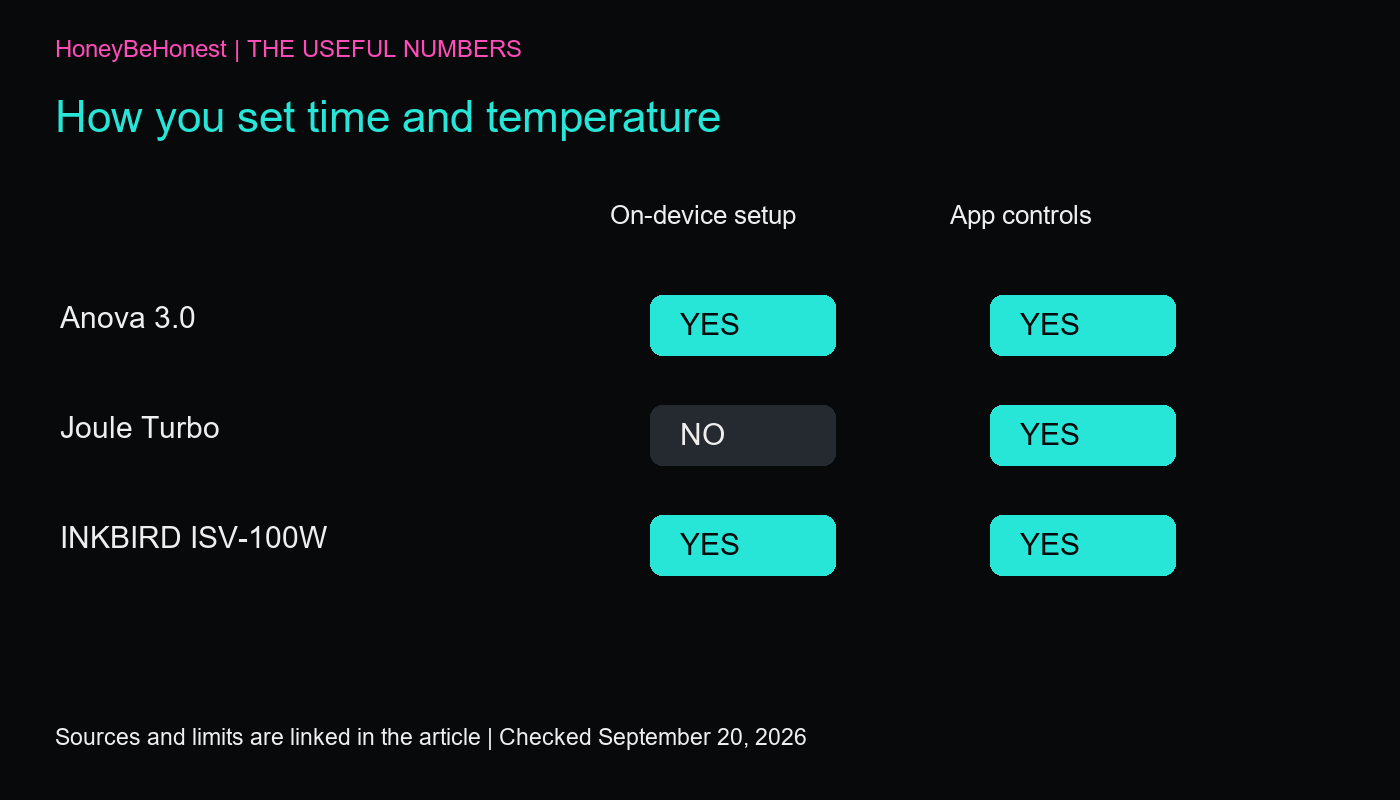
The chart compares the documented control choices: Anova 3.0 and INKBIRD ISV-100W provide local time-and-temperature controls as well as app features, while Joule Turbo uses the Breville+ app to set up its guided cooking workflow. It maps how you operate the machines; it does not rank the quality of dinner or the sophistication of their recipe libraries.
Power claims are a separate question. More rated power does not directly translate to a guaranteed number of minutes saved. Water quantity, starting temperature, vessel insulation, a lid, and the program affect the task. We have not measured heating speed or operating cost, so there is no fabricated performance race hiding behind the graphic.
What else belongs in the budget?
You need a suitable vessel, appropriate bags or containers, a way to keep the food submerged according to the recipe, and a place where a warm water bath can sit securely. Some foods benefit from a separate finishing step such as searing. A vacuum sealer can help with bag preparation, but buying the biggest one is not automatically a prerequisite for trying the method.
Follow reputable time-and-temperature guidance for the specific food and thickness, and follow appropriate cooling and storage instructions when preparing food ahead. A bath temperature alone is not a complete food-safety plan. This equipment guide does not provide a pasteurization schedule.
Does sous vide replace a meat thermometer?
It answers a different question. The circulator controls the water, while an appropriate thermometer can help you check temperatures where the recipe or procedure calls for it. Neither tool turns a guess about thickness or time into a verified result.
My choice remains Anova 3.0 for direct controls, Joule Turbo for an app-led cook, and INKBIRD ISV-100W for a simpler entry. Choose the workflow you will tolerate on a tired Tuesday. The fanciest device in the cupboard is still just cupboard decor if you refuse to take it out.
Check the exact models
View Anova Precision Cooker 3.0 on Amazon (paid link)
View Breville Joule Turbo BSV600PSS on Amazon (paid link)
View INKBIRD ISV-100W on Amazon (paid link)
Sources and related reading
Anova Precision Cooker 3.0 specifications
Current Anova app plans and manual controls
Breville Joule Turbo product information
Breville Joule Turbo BSV600 manual
Identifying original Joule versus Turbo
INKBIRD ISV-100W specifications
For another counter-space decision, read our Ninja Air Fryer Pro XL vs COSORI TurboBlaze comparison.
The Story
Sous vide has a very specific talent: making a normal dinner sound like a science fair. That is fine, but the circulator still has to earn its drawer space on a tired Tuesday when nobody wants to troubleshoot Bluetooth next to raw chicken.
Honey’s Bottom Line
Sous-vide rule: the appliance can control the water bath, but it cannot cook the steak, make the sauce, or clean the pan. Honey calls that a feature boundary, not a personal failure.
Disclosures
Affiliate disclosure: As an Amazon Associate I earn from qualifying purchases. When you use an Amazon link in this article, HBH may earn a commission at no extra cost to you.
Editorial disclosure: This is a research-based comparison using published manufacturer information and the linked product listings. Unless specifically stated, this is not a report of hands-on testing or personal use.
Artwork disclosure: The cover image is AI-generated Honey Be Honest editorial artwork and is illustrative; it is not a photograph of the exact products compared.


Leave a comment