The Verdict
For baking with large bowls, the OXO Good Grips 11-Pound scale is my Amazing pick because its display pulls out where you can see it. Escali Primo is the Good pick for straightforward weighing with two physical buttons. Etekcity EK6015 is Mid for bulky baking setups but appealing when a slim scale and a small storage footprint matter more than a movable screen.
All three belong to the ordinary kitchen-scale category. None should be bought on the assumption that a one-gram display is a laboratory certification. This is a researched comparison based on manufacturer material and exact Amazon listings checked September 20, 2026, not an HBH accuracy test. We have enough fiction in the group chat without inventing a calibration laboratory.
The Comparison
| Exact model | HBH fit | Practical difference |
|---|---|---|
| OXO 11-Pound Stainless Steel, 11214800 (paid link) | Amazing: large bowls | Pull-out display; 5,000 g maximum |
| Escali Primo P115C, Chrome (paid link) | Good: simple everyday weighing | Two buttons; 5,000 g maximum |
| Etekcity EK6015, stainless steel (paid link) | Mid: oversized bowls | Slim fixed-display body; 5,000 g maximum |
Start with the bowl, not the color
The correct kitchen scale is the one that still shows you the number after you put your mixing bowl on it. This sounds insultingly obvious until a beautiful bowl moves in and the display becomes a rumor. OXO's pull-out screen directly addresses that problem. Escali and Etekcity keep their readouts on the body, so a wide container deserves more thought.
These models all have an approximately 11-pound, 5-kilogram maximum load. The container counts toward that load even after you press tare. Tare subtracts the container from the displayed figure; it does not grant the machine supernatural lifting abilities. This distinction matters when you use heavy glass or a stand-mixer bowl.
For the exact linked versions, the OXO is the stainless-steel model 11214800, Escali is the Chrome Primo P115C, and Etekcity is the EK6015 stainless-steel kitchen scale. Do not substitute a 22-pound OXO, a different Escali model, or an Etekcity smart nutrition scale while assuming the comparison still applies.
Amazing: OXO when the mixing bowl blocks everything
OXO's useful trick is its display, which pulls away from the weighing platform. The manufacturer lists a zero function and one-gram metric increments; the platform can be removed for cleaning. This is an ergonomic argument for the scale, not evidence that its measurements outperform the others in a test we did not conduct.
I would choose it for a baker who works in a big bowl, someone portioning a batch of ingredients, or a household where different people need to read the screen without leaning around the container like they are investigating a crime. The convenience is easy to understand before you buy it: put your usual bowl on a piece of paper roughly the size of the scale and imagine where your eyes go.
The compromise is extra physical complexity. The pull-out section has to move, the platform has to fit your storage spot, and the appeal is smaller if your containers never hide a fixed display. I would not pay extra just because stainless steel looks serious next to a whisk. My whisk has seen things. It is already serious enough.
Check the live price and your cupboard dimensions. If you bake occasionally with a small bowl, the feature that makes OXO my Amazing choice may provide you with almost no advantage. That is permission to buy less, which apparently still exists on the internet.
Good: Escali Primo when simple is the whole point
The Primo uses two buttons for operation, offers tare, and measures up to 5,000 grams. Its manufacturer support documents identify the P115 family and explain that an overload message means you need to remove weight. The Chrome finish is the linked P115C version, rather than a claim that the entire body is solid stainless steel.
The appeal is a short learning curve. Set the scale on a suitable stable surface, choose the unit, place your container, zero it, and weigh. There is no reason a batch of cookies should require an account migration. For someone moving from measuring cups to weighing recipe ingredients, familiar buttons can be more useful than an ambitious feature list.
A fixed screen is the limitation. The Primo's round platform does not magically make the front readout visible beneath every oversized bowl. Think about your containers, kitchen lighting, and whether you can read the figures comfortably. If a large bowl is your regular problem, paying for the OXO display can make more sense than buying the simpler scale and improvising every time.
I would select Primo for ordinary bread, cake, and dinner prep when compact simplicity matters. It is also an easy candidate for someone who wants to weigh ingredients without turning the kitchen into a dashboard. Just do not translate “simple” into “indestructible”: keep within the stated capacity and follow its care instructions.
Mid: Etekcity EK6015 when storage wins the argument
Etekcity lists the EK6015 at 7.3 by 5.7 by 0.6 inches, powered by two AAA batteries, with a 5,000-gram capacity. Its slim form is the practical attraction. If your current storage system is shoving utensils into a drawer and hoping geometry eventually gives up, a thin scale deserves attention.
My Mid rating applies to big-bowl baking, where the compact fixed display layout offers less help than OXO's design. It does not mean that the model cannot weigh flour or portions. Someone with a small counter and small containers might reasonably choose it over both larger options. Your cupboard gets a vote even if the marketing department finds that unglamorous.
The unit list includes grams and volume-style modes. For a recipe written in grams, keep the scale in grams. A scale measures mass; a milliliter mode relies on a conversion assumption and does not make every liquid interchangeable. Oil, flour, water, and optimism do not all weigh the same per cup.
The manufacturer page was marked sold out when checked, while the linked Amazon listing was accessible. Availability can change by seller and destination. Read the current offer instead of treating this paragraph as a promise that a box will arrive tomorrow.
The Chart
The chart, because guessing is how we got here: your bowl spends part of the allowance
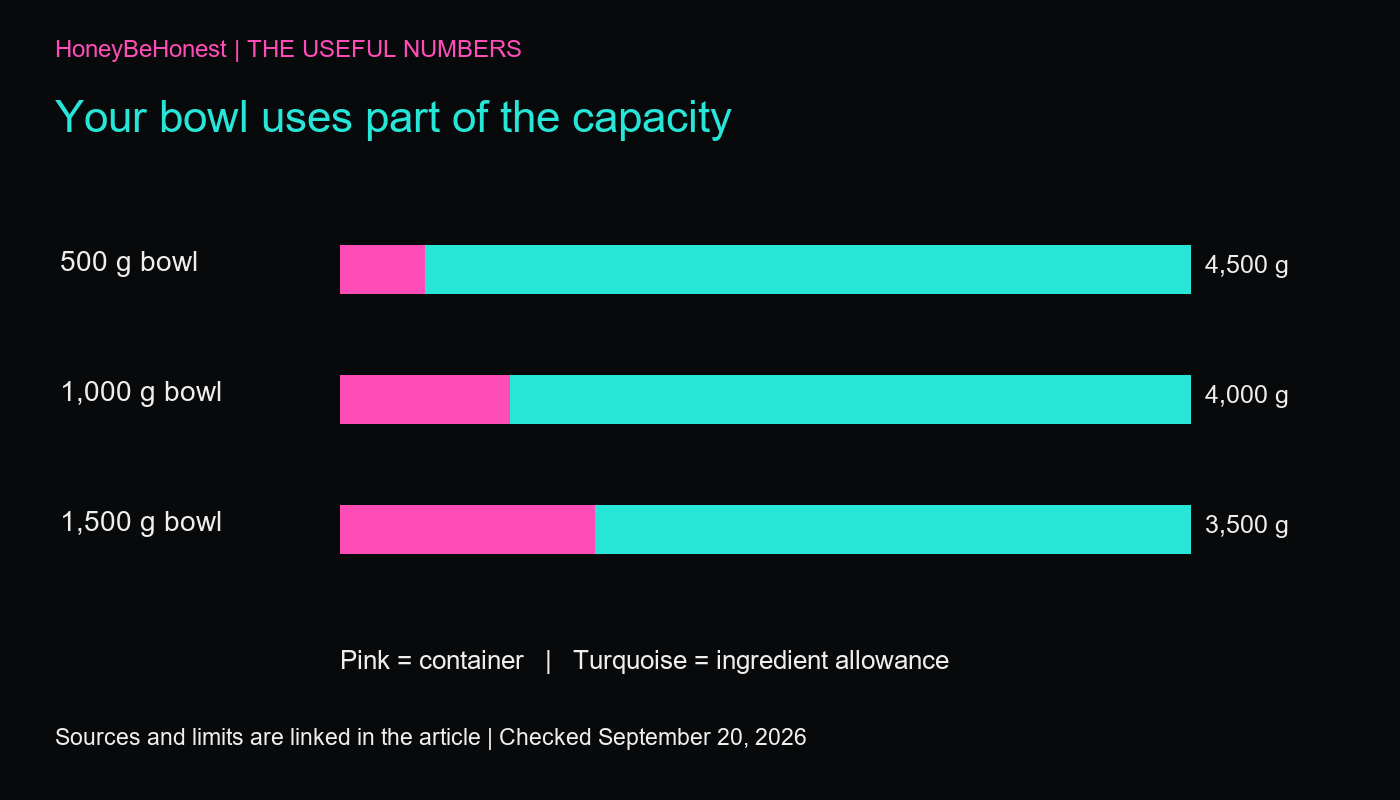
The graph begins with the manufacturers' 5,000-gram capacity and shows three explicitly hypothetical container weights: 500, 1,000, and 1,500 grams. That leaves 4,500, 4,000, or 3,500 grams for ingredients. These are arithmetic examples, not measured weights of your mixing bowls and not performance tests of the products.
The point is useful precisely because all three scales have the same nominal ceiling. If you exceed that ceiling regularly, choosing among them will not solve the problem. You need a higher-capacity scale or smaller batches. Pressing tare with increasing aggression is unlikely to persuade the load cell to negotiate.
Questions before you buy a digital kitchen scale
Does one-gram resolution mean one-gram accuracy?
No. Resolution describes the displayed step size. Accuracy is a separate question about how closely the reading matches the actual load under specified conditions. I have not tested these units against traceable weights, so there is no HBH accuracy ranking here. For very small quantities requiring tenths of a gram, choose equipment designed and specified for that task.
Can I keep adding ingredients in one bowl?
Tare lets you reset the displayed weight between additions. Keep a record of what you already added, especially if you pause long enough for the scale to turn off. Add ingredients carefully, because removing just the extra salt from a bowl of flour is not a delightful hobby I recommend adopting.
What matters beyond the numbers?
Screen visibility, button feel, cleaning, storage, and the containers you actually use. Avoid balancing an unstable tower on a tiny scale to reach the display. The right purchase should remove an annoyance, not recruit another bowl as support staff.
My choice is OXO for obstructed displays, Primo for straightforward daily weighing, and EK6015 for a small kitchen where slim storage matters. None can rescue a recipe you never read. Sadly, that remains a human department.
Check the exact models
View OXO 11-Pound Stainless Steel, 11214800 on Amazon (paid link)
View Escali Primo P115C, Chrome on Amazon (paid link)
View Etekcity EK6015, stainless steel on Amazon (paid link)
Sources and related reading
OXO 11-pound scale specifications
Escali Primo P115C manufacturer page
Escali Primo overload and support guidance
Etekcity EK6015 specifications
For another counter-space decision, read our Ninja Air Fryer Pro XL vs COSORI TurboBlaze comparison.
The Story
I have no interest in a kitchen scale that looks gorgeous until you set an actual bowl on it and the number disappears behind the thing you are weighing. That is not sleek design. That is hide-and-seek with flour on your hands.
Honey’s Bottom Line
Kitchen-scale rule: if the bowl hides the number, the number has effectively left the meeting. Honey appreciates the OXO idea for exactly that reason: the display should still exist after the bowl arrives.
Disclosures
Affiliate disclosure: As an Amazon Associate I earn from qualifying purchases. When you use an Amazon link in this article, HBH may earn a commission at no extra cost to you.
Editorial disclosure: This is a research-based comparison using published manufacturer information and the linked product listings. Unless specifically stated, this is not a report of hands-on testing or personal use.
Artwork disclosure: The cover image is AI-generated Honey Be Honest editorial artwork and is illustrative; it is not a photograph of the exact products compared.


Leave a comment