The Verdict
A vacuum sealer earns its space when it makes portioning food easy enough that you actually do it. For regular freezer prep, my Amazing choice is Anova Precision Vacuum Sealer Pro because roll storage, a cutter, and double sealing are gathered in one place. NESCO VS-12 is the Good alternative with adjustable pressure and an optional double seal. The basic Anova Precision Vacuum Sealer is Mid for a big prep session but sensible for smaller, occasional jobs.
This is a researched buying guide, not an HBH endurance test. I checked manufacturer documents and exact Amazon product pages on September 20, 2026. I have not sealed a hundred bags and triumphantly announced that the machine changed my life. A person could probably change their life by labeling the freezer first.
The Comparison
| Exact model | HBH fit | Practical difference |
|---|---|---|
| Anova Precision Vacuum Sealer Pro, ANVS02-US00 (paid link) | Amazing: regular prep | Roll storage, cutter, double seal; 110 W |
| NESCO VS-12, silver (paid link) | Good: adjustable pressure | Normal/gentle; pulse; optional double seal; 130 W |
| Anova Precision Vacuum Sealer, ANVS01-US00 (paid link) | Mid: bulk bag preparation | Slim body; separate bag-cutting setup; 80 W |
Compare the routine you want, not the loudest suction claim
All three are external suction sealers: the bag opening goes into the machine, rather than the whole bag sitting inside a vacuum chamber. That distinction matters if your dream purchase is supposed to package soup like a commercial kitchen. A moist-food setting is not the same thing as a chamber sealer's liquid-handling method.
The exact lineup is the black Anova Precision Vacuum Sealer Pro ANVS02-US00, silver NESCO VS-12, and black Anova Precision Vacuum Sealer ANVS01-US00. The linked NESCO Amazon listing says VS-12; NESCO's current product page is headed VS-12P while the description still refers to VS-12. I have used the VS-12 manufacturer catalog for that model's core specifications, and would confirm the delivered label rather than pretending that the suffix discrepancy never happened.
Amazing: Anova Pro for a freezer-prep session
Anova Pro combines built-in roll storage and a cutter with a double sealing element, pulse control, and a moist setting. Its manufacturer describes one-handed operation and rates the U.S. version at 110 watts. An accessory port broadens the possible uses, but the specific container and accessory still have to be compatible. A hole for a hose is not a universal treaty among kitchen brands.
The benefit I care about is fewer separate steps. If you make custom bags, a stored roll and built-in cutter mean less hunting through the drawer for scissors and less film wandering across the counter. A pulse option gives you more involvement when full suction is not what you want. The double seal is useful redundancy, but it does not prove every bag is leakproof regardless of wrinkles, crumbs, or how you load it.
This is my pick for somebody who regularly portions purchases or prepares several bags for sous vide cooking. It is less compelling if you only seal a couple of dry portions each month. The extras take physical space, and you still need suitable replacement bags. The machine is one purchase; the habit and supplies are the continuing relationship.
Anova's own page includes a claim about more than 100 continuous seals. I would treat that as a manufacturer claim, not a reason to ignore operating instructions or promise the same result under every condition. We do not need to turn a Sunday prep session into the appliance Olympics.
Good: NESCO VS-12 for more control over the cycle
The VS-12 catalog lists normal and gentle pressure choices, pulse operation, built-in roll storage and cutting, and bags up to 11.8 inches wide. The specification is 130 watts, and the model offers dry, moist, and double-seal choices. Those controls make it a useful alternative for someone handling different textures rather than vacuuming identical bags all afternoon.
I like the decision-making this layout supports: choose the appropriate pressure, watch the bag, and stop treating every ingredient like it needs to survive a moon landing. More suction is not automatically better when the item is easily crushed. Pulse control can give you a chance to stop early, but it still requires attention from the human standing there.
The drawback is that more buttons can mean more decisions, and the footprint deserves a real place on the counter during use. I would compare the workflow with Anova Pro before calling either a bargain. If one machine is frustrating enough that you never unpack it, its cost per successful freezer portion is not going to be flattering.
One detail to resolve at checkout is the model label: VS-12 and VS-12P currently appear across NESCO's own material. Do not assume a different suffix comes with the same included roll sizes, finish, or accessory bundle. The Amazon link in this guide is the silver VS-12 kit, not an open-ended recommendation for anything with NESCO printed on it.
Mid: basic Anova for a smaller job and a smaller setup
Anova's basic Precision Vacuum Sealer has vacuum-and-seal, seal-only, and pulse controls in a slimmer body. The manufacturer's specification sheet lists 80 watts and ten starter bags. It lacks the Pro's built-in roll-storage-and-cutter arrangement, so using pre-cut bags or keeping a separate roll and scissors is part of the bargain.
For a reader who needs an occasional bag, that trade can be perfectly reasonable. Not every kitchen task needs the deluxe edition. I would rather own a simpler appliance that fits the cupboard than a more elaborate one that requires an emotional pep talk before I lift it out.
Its Mid rating here reflects the bulk-prep buying question. If your routine involves repeatedly cutting rolls, sealing a bottom edge, filling, and then closing each bag, integrated storage can save nuisance. The basic unit does not remove those steps for you. That is a workflow distinction, not a claim that its finished seals were weaker in an HBH test.
Watch marketplace specifications carefully. Some listings repeat confusing electrical figures. Use the manufacturer's exact U.S. documentation and the rating label on the delivered unit; do not infer suction performance from an inconsistent retailer wattage field. We are buying a food sealer, not entering a spreadsheet hostage situation.
The Chart
The chart: wattage is not a personality
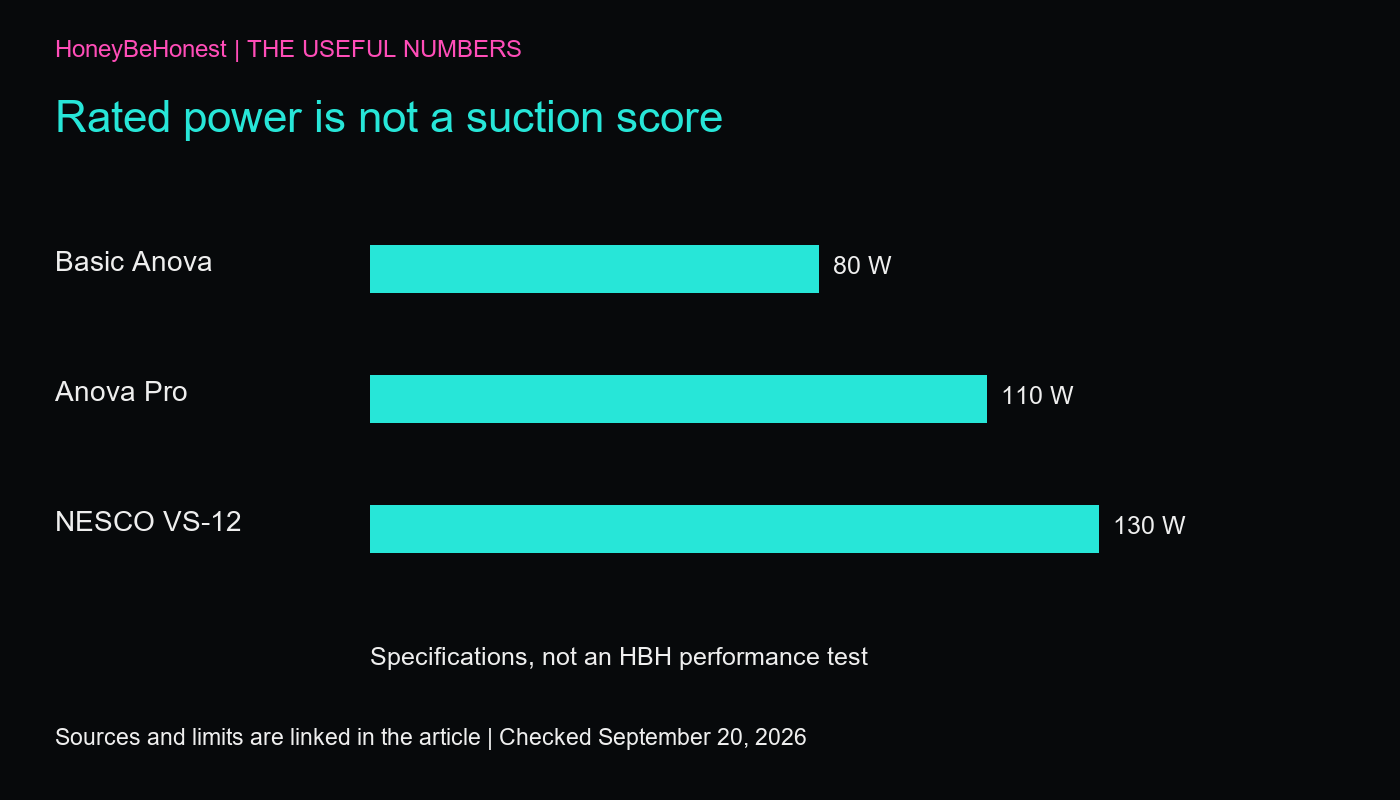
The graph compares the documented power ratings: 80 watts for basic Anova, 110 for Anova Pro, and 130 for NESCO VS-12. It is a specification comparison, not a suction-strength ranking, a measured electricity bill, or evidence that the highest number preserves food longest. Different pumps, heat-seal cycles, settings, and workloads make those different questions.
Why include it? It exposes the mistake of using one big electrical number as a shortcut for the whole purchase. The more useful comparison for most homes is still controls, bag handling, storage, and whether the machine fits the routine you intend to repeat.
Before you seal the entire refrigerator
Vacuum packaging does not turn perishable food into shelf-stable food. Follow current food-safety storage guidance, refrigerate or freeze as appropriate, and label contents and dates. This guide is about choosing equipment, not replacing a safe storage procedure with a tight plastic bag.
For liquids, follow the exact machine's instructions. Keep the sealing area clean and dry, allow enough bag material for the recommended placement, and inspect the finished seal. A double line of melted plastic is not a magical override for a crease running through both lines.
Do I need proprietary bags?
Check each manufacturer's compatibility guidance. External suction sealers need bags designed for that sealing method, and intended uses such as freezer storage or sous vide also matter. Do not assume a smooth chamber bag, an ordinary storage bag, and textured vacuum film can be swapped without consequences.
Will I save money?
Only your actual food-buying and waste habits can answer that. Count bags, storage space, and the food you genuinely use. Buying a mountain of discounted ingredients and forgetting all of it in a beautiful freezer archive is not savings; it is meal-prep scrapbooking.
I would choose Anova Pro for a regular multi-bag routine, NESCO VS-12 for adjustable-pressure flexibility, and basic Anova for occasional sealing. Get the model that makes a repeatable job easier. Then label the damn bags.
Check the exact models
View Anova Precision Vacuum Sealer Pro, ANVS02-US00 on Amazon (paid link)
View NESCO VS-12, silver on Amazon (paid link)
View Anova Precision Vacuum Sealer, ANVS01-US00 on Amazon (paid link)
Sources and related reading
NESCO current VS-12/VS-12P page
NESCO VS-12 manufacturer catalog
Basic Anova manufacturer specifications
Basic Anova manufacturer specification sheet
FoodSafety.gov cold-storage guidance
For another counter-space decision, read our Ninja Air Fryer Pro XL vs COSORI TurboBlaze comparison.
The Story
A vacuum sealer only saves money if Future You can identify what Past You sealed. Otherwise six beautiful airtight mystery bricks end up in the freezer until somebody moves and throws them away with resentment.
Honey’s Bottom Line
Freezer rule: the vacuum sealer is supposed to make dinner easier later, not create a second hobby called ‘figuring out which bag goes with what.’ Seal, label, freeze, and move on with your life.
Disclosures
Affiliate disclosure: As an Amazon Associate I earn from qualifying purchases. When you use an Amazon link in this article, HBH may earn a commission at no extra cost to you.
Editorial disclosure: This is a research-based comparison using published manufacturer information and the linked product listings. Unless specifically stated, this is not a report of hands-on testing or personal use.
Artwork disclosure: The cover image is AI-generated Honey Be Honest editorial artwork and is illustrative; it is not a photograph of the exact products compared.


Leave a comment