A container of leftovers is tomorrow’s lunch only if we handle it like food, not a tiny science project with a matching lid. The useful routine starts before dinner ends: portion promptly, refrigerate safely, record the date, and decide early which portions belong in the freezer.
This is everyday cooked-leftover guidance, not an emergency power-outage plan or a promise that every food lasts the same amount of time. If a product has stricter instructions, follow them. If the food’s handling history is unknown, a lovely glass container does not fill in the missing information.
Honey’s quick take
- Amazing habit: label while you put food away. A date you can read beats a confident guess three evenings later.
- Good plan: freeze the portions you will not eat soon. Decide before the refrigerator becomes a waiting room.
- Mid strategy: the sniff-and-hope routine. Appearance or smell cannot establish that food was safely handled.
Disclosure: As an Amazon Associate I earn from qualifying purchases. Qualifying shopping links elsewhere on HBH may earn a commission at no extra cost to you. This guide does not require buying a particular container, thermometer or meal-prep system.
Evidence checked October 4, 2026: USDA Food Safety and Inspection Service and FDA consumer food-safety guidance. The advice concerns routine household handling; it is not individual medical advice. Cover art is conceptual, not evidence of a measured cooling test.
The numbers worth putting where you can see them
Check: Prompt refrigeration
General household guidance: Within 2 hours; within 1 hour if the temperature is above 90°F
Check: Refrigerator
General household guidance: 40°F or below
Check: Refrigerated cooked leftovers
General household guidance: Generally 3–4 days, unless stricter food instructions apply
Check: Reheating leftovers
General household guidance: 165°F measured with a food thermometer
Sources: USDA leftovers guidance and FDA storage guidance. These limits are not instructions to leave food out until the last minute. Put it away promptly.
Step one: make a cooling plan before you make a mountain of food
USDA recommends dividing large amounts into shallow containers so they cool more quickly; a large pot of soup is not the same cooling situation as several smaller portions. Hot food may go directly into the refrigerator, or it can be rapidly chilled in an ice or cold-water bath first. Do not wait on the counter for the entire pot to become room temperature. USDA cooling instructions.
The practical improvement is staging. Before serving, find enough clean, suitable containers and check that their lids actually belong to them. Clear a place in the refrigerator. It is remarkably easy to postpone putting food away when doing so first requires an archaeological dig through the lid drawer.
Choose containers appropriate for the food and temperatures involved, following their manufacturer’s directions. This guide is not a claim that any glass dish can tolerate a rapid temperature change. Do not create a second problem by pouring hot food into a container whose instructions prohibit it.
Give the refrigerator room to work. FDA cautions against packing it so tightly that cold air cannot circulate. A packed shelf is not proof that the food itself has reached the needed temperature. Use an appliance thermometer rather than treating the dial number as a measurement. FDA safe-storage guidance.
Step two: label for a tired person, not a filing system
Our editorial suggestion is a simple label with the food name and the date it was cooked or prepared. Add any handling detail you actually know, such as “frozen today.” Do not write a guessed date just to make the label look finished.
Keep the label where it will be visible when the container is stacked. “Chicken, Monday” is clearer than a mysterious abbreviation on the bottom. A reusable marker or removable label can work; the best system is the one you will use before going to sit down.
Decide which meals the portions will become. Two lunches you genuinely intend to eat are a plan. Seven identical containers you hope your personality will embrace are a negotiation. If you will not use a safely handled portion within the appropriate refrigerator window, freeze it promptly rather than waiting until you are unsure.
Freezing is not a rescue procedure for food that has already sat out too long. FDA explains that freezing does not kill most bacteria. Start with safely handled food; do not ask the freezer to erase its biography. FDA safe-storage guidance.
The chart: heat shortens the room-temperature window
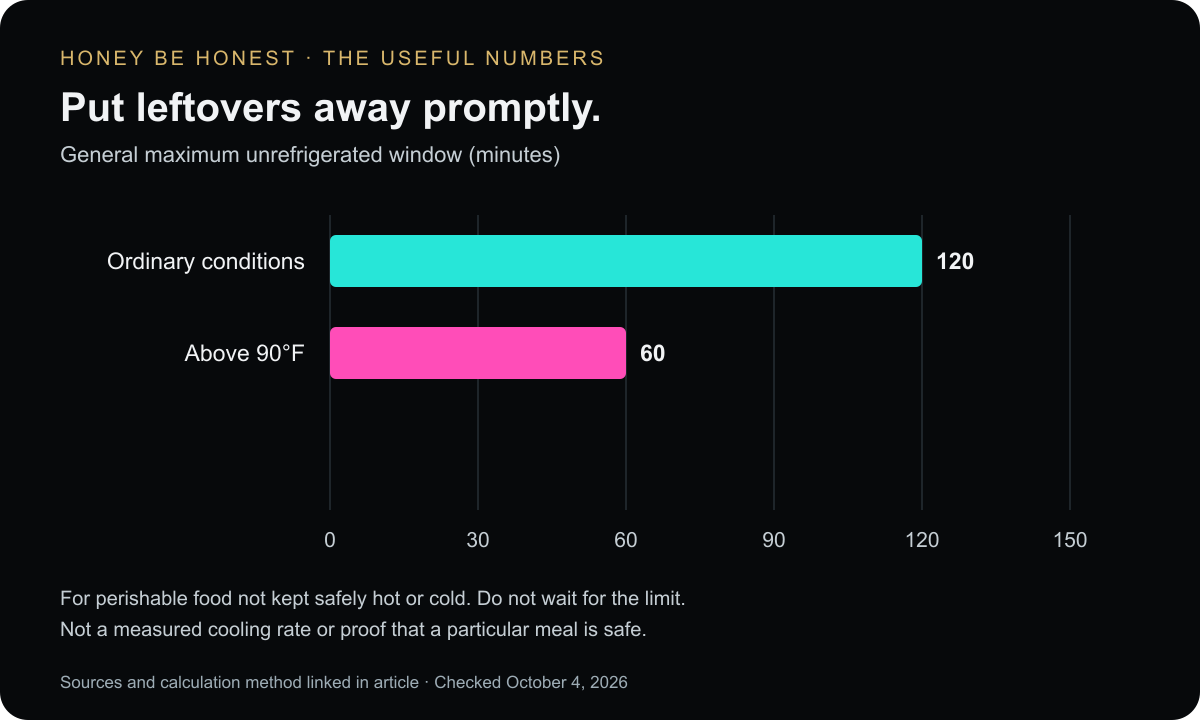
Visual in words: Ordinary conditions: 120 minutes. Above 90°F: 60 minutes. For perishable food not kept safely hot or cold. Do not wait for the limit. Not a measured cooling rate or proof that a particular meal is safe.
The bars show the familiar two-hour rule and its one-hour above-90°F limit, converted to minutes. They are maximum guidance windows for food not kept safely hot or cold, not targets, a cooling-rate experiment or a guarantee about any particular meal. Refrigerate promptly. FDA buffet guidance.
The clock does not start over because you changed bowls. Consider the whole period food has been out, including serving and transport. If the history is uncertain, be cautious rather than inventing a neat timeline after the fact.
Step three: reheat the food, not just the edges
Use a food thermometer to verify 165°F when reheating leftovers. For the microwave, FDA advises covering appropriately, stirring or rotating for even heating, and allowing standing time before checking temperature. Follow the appliance and container instructions, including safe venting. FDA safe-food-handling facts.
Checking several places is especially useful when a dish contains pieces or dense sections that may heat unevenly. Steam escaping from one edge is not the same as a temperature reading in the food. Be careful when removing covers; hot steam is not impressed by your lunch break.
Take out the portion you need rather than automatically warming the entire container. That is an organizational suggestion to reduce unnecessary handling and preserve flexibility, not a claim that a fixed number of reheats is universally safe.
What to stop doing
Do not rely on tasting food to decide whether it is safe. Do not assume a cold-feeling container proves its contents stayed at a safe temperature throughout storage. Do not let an attractive meal-prep photograph talk you into preparing more than you can safely cool and store.
If you discover a container without a reliable date or handling history, the lost serving is frustrating. Getting sick is a much worse return on the grocery budget. Improve the labeling habit rather than making an exception for the mysterious casserole.
For recipes that specify ingredient weights, our kitchen-scale comparison can help with a readable prep setup. A scale is not a food thermometer and cannot establish that reheating was safe.
You do not need a refrigerator that looks like a showroom. You need food you can identify, a temperature you have checked, and a plan you will actually follow. That is the kind of meal prep worth keeping.


Leave a comment