
Three rolls live in the same drawer. That does not mean they signed up for the same job. The fast answer: use properly rated parchment for suitable baking, wax paper for appropriate non-oven tasks, and foil where the recipe and appliance permit it. Read the specific box before the food goes anywhere near heat.
The expensive mistake is treating “paper that keeps things from sticking” as a complete material specification. A cookie tray is a poor place to discover that distinction. Let us make this decision before the smoke alarm contributes an opinion.
Honey’s quick take
- Amazing for suitable lined baking: parchment. Choose it for release and easy cleanup within the package’s temperature and appliance limits.
- Good for cool prep work: wax paper. Separating and wrapping appropriate foods is a different assignment from exposed oven baking.
- Mid as a universal swap, useful for the right task: foil. It can line or cover suitable dishes, but ordinary foil is not automatically nonstick and appliance restrictions still apply.
Disclosure: As an Amazon Associate I earn from qualifying purchases. Qualifying links elsewhere on HBH may earn a commission at no extra cost to you. This how-to contains no shopping recommendation or claim that you need to purchase a new product.
Evidence checked October 4, 2026: Reynolds manufacturer instructions and published use guidance. Temperature limits below refer specifically to the cited Reynolds parchment, not every parchment brand. This is a researched use guide, not a controlled baking test. Artwork is an editorial concept.
Start with the task, not the roll you can reach
Your task: Lining a cookie sheet in a conventional oven
Useful starting choice: Rated parchment
The check that matters: Package temperature limit; keep away from elements and oven walls
Your task: Separating suitable cooled treats
Useful starting choice: Wax paper
The check that matters: Food and storage instructions; no exposed oven heat
Your task: Covering a suitable roasting dish
Useful starting choice: Foil
The check that matters: Recipe, dish and appliance directions; no assumed nonstick finish
Your task: Broiling or using a toaster oven
Useful starting choice: Do not assume paper is allowed
The check that matters: Read the exact appliance and liner instructions first
Your task: Covering an oven floor to catch drips
Useful starting choice: Stop and check the appliance manual
The check that matters: A sheet-pan liner is not permission to line the oven itself
The comparison above is a decision aid, not a universal permission chart. A product may be suitable in one appliance and prohibited in another. “It survived last time” is not the safety specification we are looking for.
Parchment: useful, but not invincible
Reynolds lists its cited parchment as safe for conventional-oven use up to 425°F, with restrictions: avoid open flames and contact with oven sides or heating surfaces, and do not use it with a broiler or toaster oven. Different products can carry different limits; use the instructions on your own package. Reynolds parchment guidance.
That makes the first practical step wonderfully boring: read the recipe’s temperature, then read the box. If they disagree, stop. Do not average them, fold the paper into a brave little rectangle, or assume the cook time is too short to matter.
Trim a liner to fit the pan appropriately instead of leaving generous flags hanging into the oven. Think about where those edges will be when you slide the tray onto a rack. A neat liner is not just prettier in the photograph; it makes the setup easier to inspect.
Parchment also does not repair a pan-size mismatch. If a recipe needs a larger baking surface, a liner cannot create it. Check the pan’s dimensions and the recipe before deciding that cleanup is the only variable worth considering.
Wax paper: give it a non-oven job
The simplest dependable rule for an ordinary exposed cookie tray is do not substitute wax paper for parchment. Reynolds says exposed oven heat can melt the wax. The manufacturer describes a limited cake, bread or brownie pan-lining use where batter completely covers the paper; that is not permission for a bare cookie-sheet liner. Reynolds baking-paper instructions.
You do not need to memorize every exception to run a functional kitchen. If the recipe did not ask for that specific covered-batter method, choose an appropriate rated liner and leave wax paper for the work its package allows. Avoid turning a narrow exception into the household default.
Keep the label visible when you store the rolls. If you move loose sheets into an organizer, identify them clearly. Brown, translucent and shiny are appearances, not reliable operating instructions. Guests, teenagers and tired future-you should not have to conduct material identification beside a preheated oven.
Foil: a barrier is not the same as a nonstick surface
Foil is useful for lining or covering appropriate baking dishes, but the food and desired result matter. Reynolds distinguishes ordinary foil from its nonstick product and identifies parchment as a useful choice with acidic ingredients such as tomato or citrus. Follow your recipe and package, rather than expecting one surface to behave like another. Manufacturer foil-versus-parchment guide.
Decide what you are trying to accomplish. Are you catching drips inside a dish? Covering the top? Releasing a delicate baked item? Those are separate jobs. “Make washing easier” may be your goal, but it does not answer what surface belongs against the food.
Likewise, an oven-safe dish does not make every liner-and-appliance combination safe. Do not transfer conventional-oven advice to a microwave, air fryer or toaster oven without checking their directions. This article does not authorize foil in a microwave or a loose sheet near a fan-driven heating element.
The useful visual: a decision, not a fake heat contest
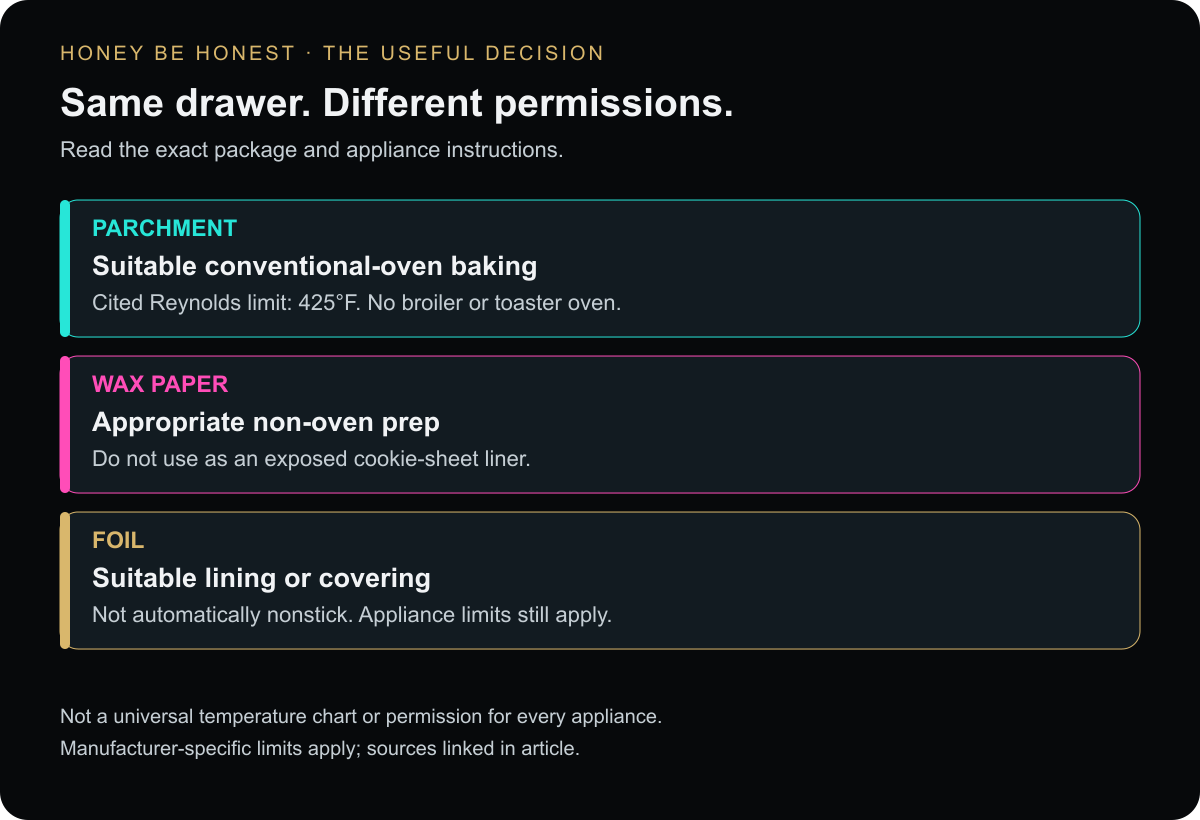
Visual in words: PARCHMENT: Suitable conventional-oven baking: Cited Reynolds limit: 425°F. No broiler or toaster oven. WAX PAPER: Appropriate non-oven prep: Do not use as an exposed cookie-sheet liner. FOIL: Suitable lining or covering: Not automatically nonstick. Appliance limits still apply. Not a universal temperature chart or permission for every appliance. Manufacturer-specific limits apply; sources linked in article.
This source-backed decision map deliberately has no “maximum heat” bar for foil or wax paper. Inventing comparable temperatures would make a tidy chart and a worse guide. The exact paper product’s limit and the appliance’s instructions control the decision.
A thirty-second setup check
Before switching on the oven, put the recipe, package and pan next to each other. Confirm the recipe’s required pan size and temperature. Confirm the liner is permitted for that heat source. Fit the liner without loose overhang, and arrange the food according to the recipe rather than crowding it to avoid a second tray.
If the roll has lost its packaging and you cannot confidently identify it, do not test it by heating it. Use an identified suitable product or the recipe’s approved alternative. That is a much smaller inconvenience than rescuing a tray after guessing.
Can I use a silicone mat instead? Possibly, but this guide has not verified your mat’s temperature, size or appliance compatibility. Follow that manufacturer’s directions and your recipe; “silicone” is not a universal approval stamp.
Does the liner replace greasing? Follow the recipe and product instructions. Do not assume a liner eliminates every preparation step for every bake.
What should I improve first? Start with the measurement the recipe actually needs. Our readable kitchen-scale comparison covers ingredient weighing, a separate issue from choosing a pan liner.
The goal is not to own every roll in the aisle. It is to give each one the right job—and stop the kitchen drawer from making decisions on your behalf.


Leave a comment