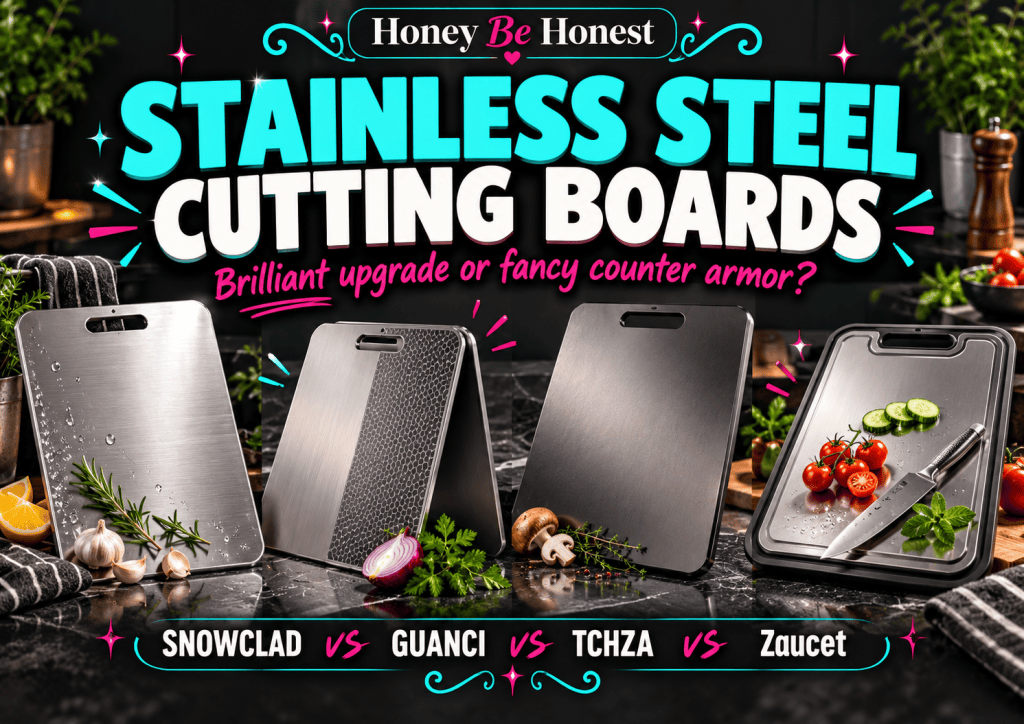
Stainless Steel Cutting Boards Are Everywhere. Brilliant Upgrade or Fancy Counter Armor?
Metal cutting boards went from weird restaurant-looking slabs to suddenly being all over shopping feeds. I wanted to know whether I was looking at a smart kitchen upgrade or a very attractive way to bully a knife.
VERDICT
If I want easy cleanup and a surface that does not soak up smells, a stainless or metal board can make sense for certain prep jobs. I would still keep a wood or softer board around for serious knife work. My favorite setup is not one magical board. It is giving raw-meat prep, produce prep and nice knives the surface that annoys each of them the least.
Disclosure: As an Amazon Associate I earn from qualifying purchases. Every Amazon shopping link in this article is an affiliate link. I may earn a commission at no extra cost to you. Prices, bundles and availability change, so I compare the actual buying differences instead of pretending a sale price has taken a blood oath.
Why I picked this topic now
This is not a tiny niche anymore. Recent Amazon-search tracking showed stainless steel cutting board up sharply year over year, while current shopping coverage is still full of vague “non-toxic” claims that do not explain what changes when a knife hits metal. That information gap is exactly the kind of thing I like digging into.
The comparison that actually matters
| Product | Type | Best for | My take | Amazon |
|---|---|---|---|---|
| SNOWCLAD 16×11 Double-Sided Board | Stainless steel + softer reverse side | People who want one board for meat and produce | The reversible idea makes more sense to me than pretending steel should do every kitchen job. | Check on Amazon |
| GUANCI 16×11 Double-Sided Board | 304 stainless + wheat-straw PP reverse | Messy prep and juice-groove people | Useful extras make this one feel less like a sheet of metal that wandered in from the garage. | Check on Amazon |
| TCHZA Stainless Steel Cutting Board | Stainless steel | Simple metal-surface prep | The straightforward option if the entire point is easy cleanup and no plush features. | Check on Amazon |
| Zaucet Titanium Cutting Board | Titanium-style metal board | People specifically shopping the newer titanium category | Interesting, but I would verify the exact material construction on the current listing before paying a premium. | Check on Amazon |
The part the pretty product photo skips
Metal does three things really well: it does not absorb onion perfume for the rest of its natural life, it is easy to wipe down, and it does not develop the same deep knife grooves as a soft plastic board. That sounds perfect until the knife joins the meeting.
A hard cutting surface can be tougher on an edge than wood or a softer synthetic board. That does not mean a stainless board is useless. It means I would not turn it into the permanent home for my nicest chef’s knife just because the board looks clean enough to perform surgery on.
What I would use one for
Raw meat: this is where the easy-clean appeal makes the most sense to me. Dough: a big smooth board can double as a work surface. Produce: fine, especially on a reversible model. Hours of chopping: I would reach for wood or another knife-friendlier surface.
Three things I would check before ordering
1. Actual usable size. A 16-inch board sounds huge until a groove and border steal some of the surface. 2. What “double-sided” really means. Some have metal on one side and a softer material on the other. 3. Cleaning instructions. Do not assume every glued, bonded or double-sided board belongs in a dishwasher just because the word stainless appears somewhere in the title.
My pick by personality
If I want the most flexible everyday setup, I would start with GUANCI or SNOWCLAD. If I specifically want to test the titanium trend, Zaucet is the one I would compare. If I just want a plain metal prep surface without turning the purchase into a dissertation, TCHZA gets the short-list spot.
Honey, Be Honest: Why I Went Looking
I went looking because a cutting board should not require a family meeting. Then I discovered the internet had turned “where do I chop an onion?” into a materials-science debate involving steel grades, titanium, microplastics and people who appear emotionally committed to maple. At that point I needed a chart. Apparently this is who I am now.
Research note
Trend context checked October 5, 2026 using current Amazon kitchen-search trend data and recent cutting-board market coverage. Product listings can change; I recheck the current Amazon listing before ordering.


Leave a comment