VERDICT: An 8-inch round pan and a 9-inch round pan are not basically twins. That one extra inch changes the surface area enough to affect batter depth, bake time, and the odds of me staring through the oven door wondering why the cake has chosen violence.
I do the math before I move the batter. If the pans are the same shape and depth, area gives me the useful comparison; after that, I adjust expectations instead of pretending the recipe did not notice the swap.
VERDICT
- Amazing first choice: use the recipe’s specified pan. Especially for an unfamiliar or delicate cake, remove a variable instead of inventing one.
- Good for an informed adjustment: compare area and depth. The ratio helps with batter quantity, but material and baking behavior still matter.
- Mid method: “it is only an inch.” Diameter is not capacity, and optimism is not overflow protection.
Disclosure: As an Amazon Associate I earn from qualifying purchases. Every Amazon shopping link in this comparison is an affiliate link, which means I may earn a commission at no extra cost to you. Amazon prices and availability can change faster than butter disappears off a hot biscuit, so I am comparing the pans by size, construction, coating and usefulness instead of pretending today’s price will still be today’s price next week.
10 cake pans I would actually compare before buying
If I am buying an 8- or 9-inch round pan, I care about four things before I care about the logo stamped on the bottom: the inside diameter, the depth, the metal, and whether the surface is coated. Those four details tell me more about how the pan will behave than a product photo ever will. I also want to know whether I am buying one pan or a pair, because discovering I own exactly one layer pan halfway through a two-layer cake is the kind of math problem I do not need.
My quick read: I would look at Fat Daddio’s or Nordic Ware first when I want straightforward aluminum, USA Pan when I want a heavier coated pan, Chicago Metallic when I want sturdy commercial-style construction, and Wilton’s two-packs when I want two matching layers without buying twice. I would still match the recipe’s required diameter and depth before choosing the winner.
| Pan | Size | Material / surface | What I like it for | Amazon |
|---|---|---|---|---|
| Fat Daddio’s PRD-83 | 8 × 3 in | Anodized aluminum, uncoated | Tall layers and recipes that specifically want a deeper pan | Check the 8×3 Fat Daddio’s pan |
| Fat Daddio’s PRD-93 | 9 × 3 in | Anodized aluminum, uncoated | A deeper 9-inch layer without moving to a springform pan | Check the 9×3 Fat Daddio’s pan |
| Nordic Ware Naturals 8-inch | 8 × 2 in class | Natural aluminum, uncoated | Classic layer cakes when I want simple aluminum and no applied nonstick coating | Check the Nordic Ware 8-inch pan |
| Nordic Ware Naturals 9-inch | 9-inch round | Natural aluminum, uncoated | A standard 9-inch layer pan with straightforward construction | Check the Nordic Ware 9-inch pan |
| USA Pan 8-inch Round | 8 × 2 in baking surface | Aluminized steel with Americoat silicone nonstick | A heavier pan when easy release matters to me | Check the USA Pan 8-inch pan |
| USA Pan 9-inch Round | 9 × 2 in baking surface | Aluminized steel with Americoat silicone nonstick | A sturdy coated 9-inch option with a reinforced feel | Check the USA Pan 9-inch pan |
| Chicago Metallic Professional 8-inch | 8 × 2 in | Heavy-weight aluminized steel, nonstick | Straight-sided layer cakes and a more commercial-style pan | Check the Chicago Metallic 8-inch pan |
| Chicago Metallic Professional 9-inch | 9 × 2 in | Heavy-weight steel, nonstick | A sturdy 9-inch layer pan when I want coated steel rather than bare aluminum | Check the Chicago Metallic 9-inch pan |
| Wilton Aluminum 8-inch, 2-pack | Two 8 × 2 in pans | Aluminum, uncoated | Two matching 8-inch layers in the oven at the same time | Check the Wilton 8-inch 2-pack |
| Wilton Performance 9-inch, 2-pack | Two 9 × 2 in pans | Anodized aluminum, uncoated | A practical two-layer 9-inch setup without mixing pan styles | Check the Wilton 9-inch 2-pack |
My short version: For a basic uncoated layer pan, I would start with Nordic Ware or Fat Daddio’s. If I want a deeper cake, the 3-inch Fat Daddio’s pans make that choice obvious. If I want coated steel and easier release, USA Pan or Chicago Metallic gets my attention. If I am building a two-layer cake from scratch and own exactly zero matching pans, the Wilton two-packs are the least complicated answer.
Measurement chart #1: diameter vs. actual baking area
This is the chart I wish pan labels printed in giant letters. Diameter grows in a straight line; area does not. That is why one extra inch can act like it pays rent.
| Round pan | Base area | Compared with 8-inch | What that means to me |
|---|---|---|---|
| 6 in | 28.27 sq in | 56.3% | Much smaller layer |
| 7 in | 38.48 sq in | 76.6% | Still meaningfully smaller |
| 8 in | 50.27 sq in | 100% | Baseline |
| 9 in | 63.62 sq in | 126.6% | 26.6% more base area than 8-inch |
| 10 in | 78.54 sq in | 156.3% | Now I am definitely scaling |
| 12 in | 113.10 sq in | 225.0% | This is not a casual substitution |
Measurement chart #2: diameter + depth changes the amount of space fast
For ideal straight-sided pans, geometric volume is base area × depth. These numbers are full-to-the-rim theoretical volume, not a safe batter fill line. I am using them to compare pan size, not to suggest filling a cake pan like a swimming pool.
| Pan size | Base area | Theoretical volume | Approx. cups to rim |
|---|---|---|---|
| 8 × 2 in | 50.27 sq in | 100.53 cu in | 6.96 cups |
| 8 × 3 in | 50.27 sq in | 150.80 cu in | 10.44 cups |
| 9 × 2 in | 63.62 sq in | 127.23 cu in | 8.81 cups |
| 9 × 3 in | 63.62 sq in | 190.85 cu in | 13.22 cups |
The part I would not skip: going from 8×2 to 8×3 adds 50% more geometric depth capacity without changing the cake’s diameter at all. A recipe asking for an 8×2 and a recipe asking for an 8×3 are not asking me for the same pan wearing different shoes.
Measurement chart #3: quick ingredient scaling between 8 and 9 inches
If I am intentionally keeping roughly the same batter depth, the area ratio gives me a useful first-pass scaling factor: 8 → 9 inches = ×1.266, and 9 → 8 inches = ×0.790. This is geometry, not permission to get reckless with eggs or leavening.
| Original amount | 8-inch recipe → 9-inch | 9-inch recipe → 8-inch | My practical note |
|---|---|---|---|
| 1/4 cup | 0.316 cup | 0.198 cup | Use weight if precision matters |
| 1/2 cup | 0.633 cup | 0.395 cup | Awkward cup fractions show up fast |
| 1 cup | 1.266 cups | 0.790 cup | Easy math; still watch recipe chemistry |
| 1 1/2 cups | 1.898 cups | 1.185 cups | A kitchen scale starts earning its drawer space |
| 2 cups | 2.531 cups | 1.580 cups | Do not round everything in the same direction |
| 3 cups | 3.797 cups | 2.370 cups | At this point I want weights, not vibes |
What I would buy for the job
For ordinary two-layer cakes: I would choose two matching 8×2 or 9×2 pans and stop making my life harder than the frosting already plans to.
For taller single layers: I would look at a true 3-inch-deep pan such as the Fat Daddio’s PRD-83 or PRD-93, then make sure the recipe actually supports that depth.
For easiest release: I would look hardest at the coated USA Pan and Chicago Metallic options.
For simple uncoated aluminum: Nordic Ware, Fat Daddio’s and Wilton are the group I would compare first.
For a first two-pan set: the Wilton 8-inch or 9-inch two-packs are the straightforward choice because two matching layers arrive in one order instead of me discovering later that my “identical” pans are distant cousins.
Product-spec check: I compared manufacturer-published dimensions and materials where available, including Nordic Ware, Fat Daddio’s, USA Pan and Chicago Metallic, and cross-checked the Amazon catalog identifiers used in the affiliate links. I still recommend checking the Amazon listing before ordering because product revisions and bundled quantities can change.
Evidence checked October 4, 2026: King Arthur Baking’s pan-size guidance, with independently calculated circle areas and ratios shown below. This is a geometry-and-planning guide, not an HBH bake test. It does not guarantee a successful conversion for every recipe.
The simple calculation that changes the decision
For a round pan, base area is π × radius². Radius is half the diameter. Using the named interior diameters for an idealized straight-sided circle:
Round pan: 8-inch
Radius: 4 inches
Calculated base area: 50.27 square inches
Relative to an 8-inch pan: 100%
Round pan: 9-inch
Radius: 4.5 inches
Calculated base area: 63.62 square inches
Relative to an 8-inch pan: 126.56%
The ratio is 81 ÷ 64 = 1.265625. Going the other direction gives 64 ÷ 81 = 0.790123, so an 8-inch pan has about 79% of the 9-inch pan’s base area. Notice that the reverse difference is about 21% less, not 26.6% less. Percentages depend on which pan is the starting point.
These are calculations, not measurements of a particular branded pan. Sloped sides, rounded corners, actual interior dimensions and depth change capacity. Measure the pan you have and compare it with the recipe rather than treating the label as a complete diagram.
Why the same batter behaves differently
Put the same amount of batter into a wider pan and, all else equal, the batter layer is shallower. Put it into a smaller pan and it is deeper. That changes the setup the recipe developer tested. The timer cannot magically remove the change.
King Arthur explains that pan dimensions affect the bake and warns that moving a recipe into too-small a pan can cause overflow or an uneven result. Its guidance also distinguishes pan material and color: those variables can affect how a bake develops. Why pan size matters.
Do not convert an area ratio into a time ratio. A pan with 26.6% more area does not automatically need 26.6% more or less baking time. I do not have a universal formula for that, and pretending otherwise would produce a very confident ruined cake.
The practical implication is to choose the simplest route. If the recipe offers a tested alternative pan, follow that. If it does not, and the cake is for an important event, using the specified pan is usually the lower-uncertainty decision. Experimental cake is lovely when it is not also responsible for a birthday deadline.
Depth is the part the overhead photograph hides
Two pans can share a diameter and still differ in depth. A springform pan is not automatically interchangeable with a shallower conventional cake pan. King Arthur specifically discusses how pan height changes total capacity and baking conditions. Pan depth and material guidance.
For ideal straight sides, full geometric volume equals base area times depth. But full-to-the-rim volume is not a safe batter fill level. Cakes rise, recipes behave differently, and the appropriate headroom depends on the tested recipe. Do not pour batter to the rim because a volume calculation says it technically fits.
Measure the usable interior, not the handles or rolled rim. Write down diameter and depth together. “The big round one” is a perfectly acceptable family nickname; it is not useful information when adjusting a recipe.
The graph: the inch is doing more than it appears
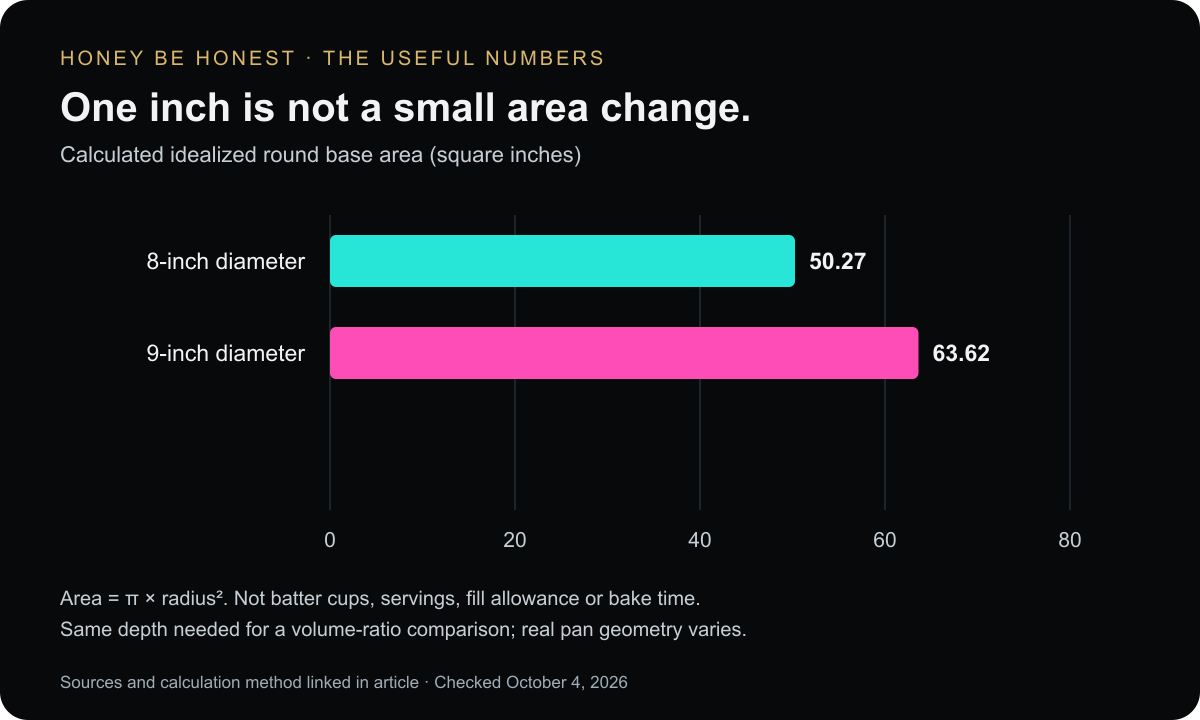
Visual in words: 8-inch diameter: 50.27 square inches of calculated idealized base area. 9-inch diameter: 63.62 square inches of calculated idealized base area. Area = π × radius². Not batter cups, servings, fill allowance or bake time. Same depth needed for a volume-ratio comparison; real pan geometry varies.
This zero-based chart shows square inches of idealized base area, not batter cups, servings or baking time. Equal depth is needed before the area ratio also describes a full geometric volume ratio. It is not an endorsement of filling either pan completely.
If you decide to scale, scale the recipe—not your confidence
For an otherwise appropriate recipe and equal intended batter depth, the area ratio can be an initial quantity guide. Moving from one 8-inch round layer to one 9-inch round layer suggests multiplying ingredient quantities by approximately 1.266. Moving from one 9-inch layer to one 8-inch layer suggests approximately 0.790. This preserves a geometric relationship; it does not validate the recipe’s chemistry or method.
That distinction matters with eggs, leavening and very small ingredient quantities. Do not casually round a fraction of an egg or a leavener amount and assume the cake will forgive every adjustment. A tested scaled recipe is the better route when the required fractions become awkward.
King Arthur’s alternative-pan guidance offers practical examples and emphasizes matching the bake to the available pan. Use it as a recipe-specific reference, not as permission to swap any shape, material and depth at once. Alternative pan sizes.
My editorial checklist: record the original pan, the proposed pan, their interior dimensions, the number of layers and the recipe’s fill guidance. Change as few variables as possible. Keep notes so a successful result becomes repeatable rather than a story about that one cake that mysteriously worked.
A few questions worth settling before you start
Can I put a two-layer recipe into one deeper pan? Not automatically. The total batter may fit geometrically while the baking method no longer works. Look for a tested single-pan version.
Can I use the leftover batter for cupcakes? Only if the recipe provides suitable directions or you are prepared for a separate, appropriately checked experiment. Do not invent a universal cupcake time from the cake-pan calculation.
Will a scale help? A scale is useful when a recipe supplies weight measurements and when dividing suitable batter accurately. My kitchen-scale comparison focuses on readable displays and everyday handling, not a guarantee of successful recipe conversion.
The shortest route to a good cake is often the pan the recipe asked for. When you do change it, let the math clarify the decision—and let the recipe, not wishful thinking, handle the baking.
Honey, Be Honest: One Inch Has Audacity
There are measurements that feel harmless until baking gets involved. One inch sounds tiny. One inch in a cake pan apparently shows up with opinions, a calculator, and a plan for my afternoon.
I would rather spend thirty seconds checking the pan math than forty minutes discovering that optimism is not a leavening agent. Baking already has enough chemistry. I do not need geometry sneaking up behind me too.


Leave a comment