
Choose full access when students should get the whole course, drip access when lessons should arrive gradually, and partial access when an offer includes only selected modules. Then decide separately when access begins. “What can they see?” and “When can they see it?” are two different questions.
That distinction sounds small until a paying student opens an empty-looking dashboard and you spend your afternoon writing apologetic emails. A locked lesson can be working exactly as configured while still delivering a lousy surprise.
Honey’s quick take
Amazing: Full access for a self-paced reference course that students need to use in their own order.
Good: Drip access when the learning plan genuinely benefits from pacing—and the sales page explains it.
Mid: Complicated access tiers before you have mapped which modules each buyer is actually purchasing.
Affiliate disclosure: HBH may earn a commission at no extra cost to you if you purchase through our Systeme.io affiliate link. Access decisions below are based on the reader’s needs, not a promised financial result.
How we researched: We reviewed official Systeme.io course and enrollment documentation on October 4, 2026. Recommendations and examples are editorial; we are not claiming Honey’s ownership, a hands-on course launch or measured student outcomes.
Conceptual editorial illustration—not an actual Systeme.io interface.
Use two decisions, not one confusing pile of settings
The official access guide lists four options: all content immediately; content released gradually; selected modules only; or selected modules with gradual release. Full access ignores configured lecture delays. The partial-with-drip option combines a smaller content entitlement with pacing. Access-type documentation.
Learning promise: “Use this reference library whenever you need it”
Reasonable starting choice: Full
Question to resolve before selling: Can people find the right lesson without completing everything?
Learning promise: “Work through the material in stages”
Reasonable starting choice: Drip
Question to resolve before selling: Have you explained the release rules before purchase?
Learning promise: “This starter edition includes these specific modules”
Reasonable starting choice: Partial
Question to resolve before selling: Are the included module names explicit?
Learning promise: “This limited edition releases its included lessons gradually”
Reasonable starting choice: Partial with drip
Question to resolve before selling: Is the added complexity worth maintaining?
The comparison above is an editorial fit guide, not a ranking of teaching methods. A paced program is not automatically more effective, and immediate access is not automatically overwhelming. Your subject and audience matter.
Full access is often the sensible boring option
Suppose you are selling a reference course on maintaining a home budget. One learner needs the spreadsheet lesson today; another needs the irregular-income lesson. Making both wait for a lesson timer may add frustration without improving the product.
For that hypothetical course, full access plus a suggested starting route can be a cleaner promise. A “start here” lesson and descriptive module titles provide guidance without pretending every student has the same schedule.
Do not select full access merely because it sounds generous, though. If your offer explicitly promises a staged cohort experience, the access setting needs to support that promise. The point is consistency, not selecting the fanciest option.
Partial access is about the offer’s boundaries
Write an entitlement sheet before building tiers. Give each offer a name and list the modules it includes. A starter offer might contain the basics; a complete offer might add advanced material. These are illustrative structures, not recommendations to withhold essential instructions.
Read the starter sales page as if you were buying it. Can you finish its promised task without the excluded modules? If not, you have a product-description problem, not a settings problem.
Use a distinct test learner for each tier. Your administrator account may show more than a normal student should see. Checking what the creator sees cannot establish what a paying student receives.
A launch date is not the same as drip pacing
For a common launch, the order-form course resource can be set to grant access on a specific date. Systeme.io says the course unlocks at midnight in the main account’s timezone, while the enrollment email can arrive immediately after payment. Make that gap clear in your welcome instructions. Scheduled-access guide.
Write the opening date with a timezone on the sales page. “Monday” is not enough for a student on another continent, and “you’re enrolled” should not imply “everything is open this second.”
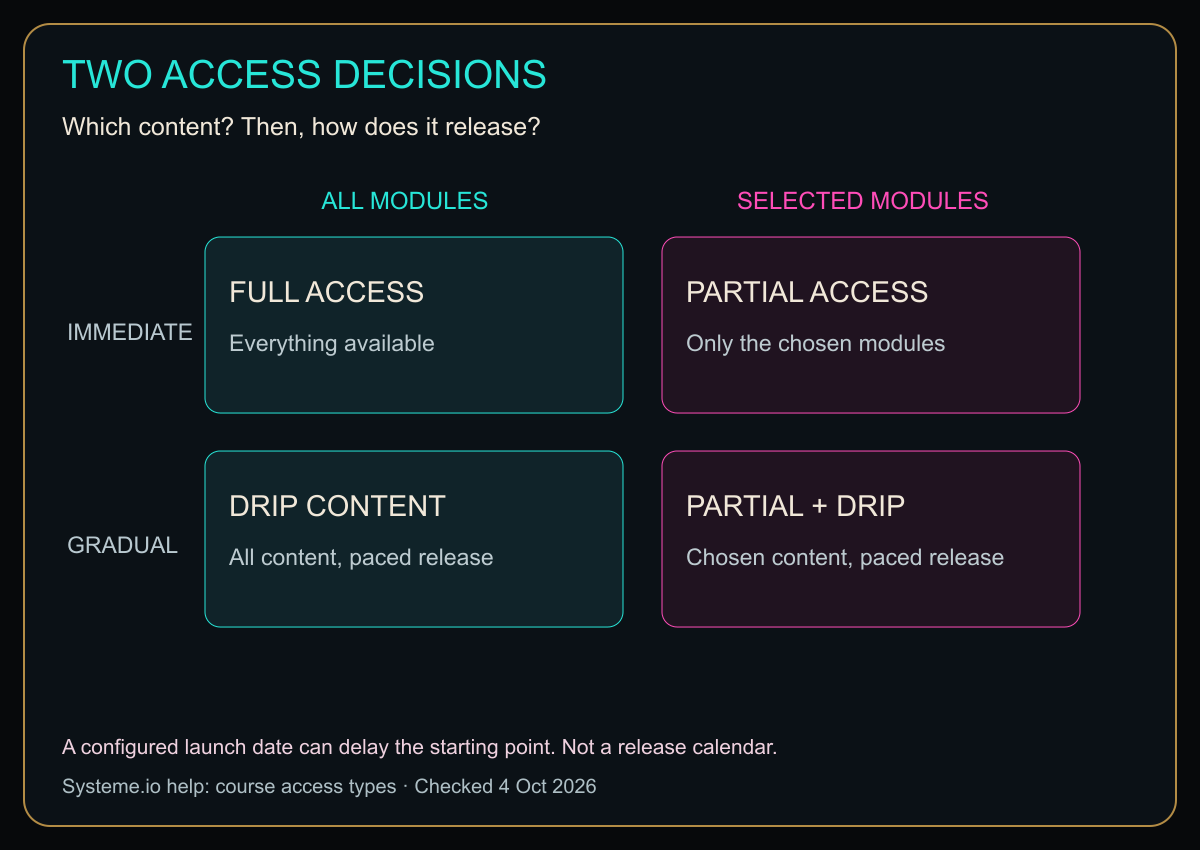
Original HBH decision map based on Systeme.io’s four documented access types. It is not a release calendar or a claim about learning results. A configured launch date can delay the starting point.
Map in words: All modules with immediate availability means full access. Selected modules with immediate availability means partial access. All modules released gradually means drip content; selected modules released gradually means partial with drip. A configured launch date can delay the starting point.
Build the paid enrollment path deliberately
The official sales guide places the course under the order form’s digital-product resources. Choose the intended course and access type, then configure the offer’s price plan. A price plan is needed to save that digital product. Enrolled students receive an automatic access email; the guide currently says that automated enrollment email cannot be customized. Course-selling setup.
Your own welcome material can still explain what happens next. Keep it operational: where to sign in, what is available now, what is scheduled later, and how to request help. Do not duplicate a password or invent login credentials in a welcome message.
There are also enrollment routes besides a purchase, including an opt-in automation, manual enrollment and a tag-triggered enrollment action. Check the route you actually intend to use; a successful manual test does not validate the paid order form. Enrollment methods.
The timing caveat we would not gloss over
The access guide’s wording about drip timing is not entirely consistent: one passage describes delay after viewing the prior lecture, while an example reasons from elapsed enrollment time. Its expiration notes also need care alongside the separate sales and launch-date guides. We would not turn that into a confident day-by-day promise without an account-level test or clarification from support. Access guide.
For a paid offer with a strict release calendar, test the exact course, enrollment method, timezone and access type before writing dates into a customer commitment. If timed access is business-critical, get the provider to confirm the behavior you require. Documentation uncertainty is not something customers should discover for you.
A practical prelaunch acceptance sheet
For each offer, record the expected result and the actual result for these checks:
- New student: Enrollment reaches the correct email address, and the student can sign in.
- Included content: Every promised module is available at the appropriate stage.
- Excluded content: A lower-tier student cannot access material outside that purchase.
- Before launch: The learner sees an understandable next step rather than a confusing dead end.
- After launch: The access change happens in the intended timezone.
- Later lessons: Test the real pacing; do not infer it from a screenshot of the settings.
- Support route: A student knows whom to contact without publicly sharing account details.
This is our suggested runbook, not evidence that these account checks have already been performed. Keep screenshots private where they contain student data, and avoid creating a pile of test contacts inside your live marketing audience.
Who should use this approach—and who should keep looking?
Systeme.io is relevant if you want to connect a course offer to enrollment in the same platform. Before committing, check the current plan’s course limits and whether its access behavior matches your delivery promise. If you need a highly specific examination, accreditation or institutional learning workflow, verify those requirements separately; these access settings do not establish that the platform meets them.
Explore Systeme.io through HBH’s affiliate link
For the bigger picture of moving a visitor toward an offer, see our plain-English guide to sales funnels.
Does full access honor lecture delays?
No. The official access guide says full access ignores them. Choose an access type consistent with the pacing you advertise.
Does an enrollment email mean the course has opened?
Not necessarily. Scheduled access can begin later than the payment and enrollment message. State the opening date and timezone clearly.
Should I make several tiers immediately?
Only if the tiers solve distinct customer needs and you can maintain their boundaries. One clearly delivered course beats four mysteriously locked ones.
Make the access promise understandable before making the access settings clever. The student bought a course, not a scavenger hunt for the lesson they already paid for.
Sources and checks
- Systeme.io: four course access types, updated May 13, 2026.
- Systeme.io: specific-date access, updated June 25, 2026.
- Systeme.io: selling a course, updated June 25, 2026.
- Systeme.io: enrollment methods, updated January 19, 2026.
Checked October 4, 2026. Verify live behavior before promising release dates or expiry rules.


Leave a comment