You bought a skillet to make dinner, not to inherit an argument about soap. For ordinary seasoned, uncoated cast iron, a manageable routine is hand washing, thorough drying and a very thin coat of oil. A full oven-seasoning session is a different job, not an automatic requirement after every meal.
This guide follows Lodge’s instructions for seasoned cast iron. It does not apply the same routine to enameled cookware, nonstick-coated pans, cookware with incompatible handles, or an unidentified damaged antique. Read your own manufacturer’s instructions first. The color black is not a material certificate.
Honey’s quick take
- Amazing habit: clean and dry promptly. A realistic routine is better than an elaborate ritual you keep postponing.
- Good when needed: a proper thin-layer reseasoning. Follow the cookware manufacturer’s method; more oil is not more protection.
- Mid advice: “never soap, never scrub, never question.” Lodge allows a small amount of soap for ordinary cleaning. Folklore does not outrank the maker.
Disclosure: As an Amazon Associate I earn from qualifying purchases. Qualifying shopping links elsewhere on HBH may earn a commission at no extra cost to you. This care guide does not require a branded cleaning kit.
Evidence checked October 4, 2026: Lodge’s seasoned-iron care, seasoning and troubleshooting instructions. This is a researched maintenance guide, not an account of an HBH restoration experiment. Artwork shows generic conceptual cookware, not an exact Lodge product photograph.
First, identify what needs fixing
What you see: Ordinary cooking residue
Sensible next step: Routine wash, dry and thin oil layer
What not to assume: Every meal requires stripping the pan
What you see: Food stuck to the surface
Sensible next step: Follow the manufacturer’s scraping/cleaning guidance
What not to assume: Add oil over the residue and call it seasoning
What you see: A sticky or gummy finish
Sensible next step: Review excess-oil troubleshooting
What not to assume: A thick shiny layer must be better
What you see: Rust or damaged coating
Sensible next step: Identify the cookware and follow the relevant restoration guidance
What not to assume: Every black pan is bare cast iron
The comparison above is a routing tool, not a diagnosis of a pan we cannot inspect. If the material, coating or damage is unclear, ask the maker before using an aggressive treatment.
Routine cleaning: make the ordinary job ordinary
Lodge’s basic sequence is to wash by hand, dry completely and wipe on oil. Its official cleaning guidance permits a small amount of soap and an appropriate scraper for stuck residue. Soaking or putting seasoned cast iron through the dishwasher is not the routine to borrow from your stainless-steel saucepan. Lodge beginner care guidance and official cleaning demonstration.
Work when the pan is safe to handle. Protect yourself from heat and do not create a sudden temperature shock by plunging hot cookware into cold water. Have the towel and safe resting place ready before lifting a heavy skillet into the sink. Cleaning a pan is much easier when you are not improvising its landing zone.
Remove the actual food residue. Seasoning is a deliberately formed oil layer, not permission to preserve last Tuesday’s dinner on the cooking surface. If something is stubborn, use the maker’s recommended method rather than increasing force until the tool or coating loses the argument.
Dry the cookware thoroughly, including the handle, rim and underside. Then use only a thin film of suitable oil and wipe away excess. The pan should not look as if it is awaiting a deep-frying audition. A simple routine that fits your kitchen is more valuable than an internet ceremony with six specialty bottles.
When an oven-seasoning session makes sense
Lodge describes seasoning as oil baked onto iron through polymerization. Its reseasoning method starts with clean, dry cookware and a thin, even oil layer; too much oil can leave a sticky result. The cited directions use an oven at 450–500°F for one hour, with the pan upside down and a drip-catching arrangement, followed by cooling in the oven. Lodge seasoning instructions.
Those numbers belong to that specific manufacturer method. They are not permission to place every pan, removable grip or accessory in a hot oven. Confirm the whole item is suitable and follow your oven’s instructions about foil placement. Do not line an oven floor simply because a cookware guide mentions catching drips.
Give the process time and ventilation appropriate to your kitchen, and keep people and pets away from hot surfaces. Do not leave the appliance unattended just to make this feel like a passive cleaning shortcut. If a step conflicts with the appliance’s manual, resolve the conflict before heating anything.
You also do not need to perform a full reset because the finish is not photographically uniform. The practical question is the condition of the cookware and what the manufacturer recommends—not whether it looks like a glossy advertisement under studio lights.
Sticky, rusty or flaky: choose the right branch
For a sticky surface, Lodge identifies excess oil buildup as a cause and gives a bake-off approach. Its troubleshooting page separately describes removing rust, applying a thin oil coat and reseasoning, and addresses flaking seasoning. Those are distinct situations; do not collapse them into “scrub everything down to bare metal.” Lodge troubleshooting.
Our editorial advice is to change one appropriate thing at a time. If you keep adding more oil to a sticky pan, you may be repeating the problem rather than solving it. Read the relevant branch of the instructions, complete it, and reassess.
Do not use this article to approve a cracked pan, an unknown coating or a thrift-store item with uncertain prior use. A familiar shape does not reveal what has been applied to it. Contact the manufacturer when identification or condition is in doubt.
The useful visual: routine care versus repair
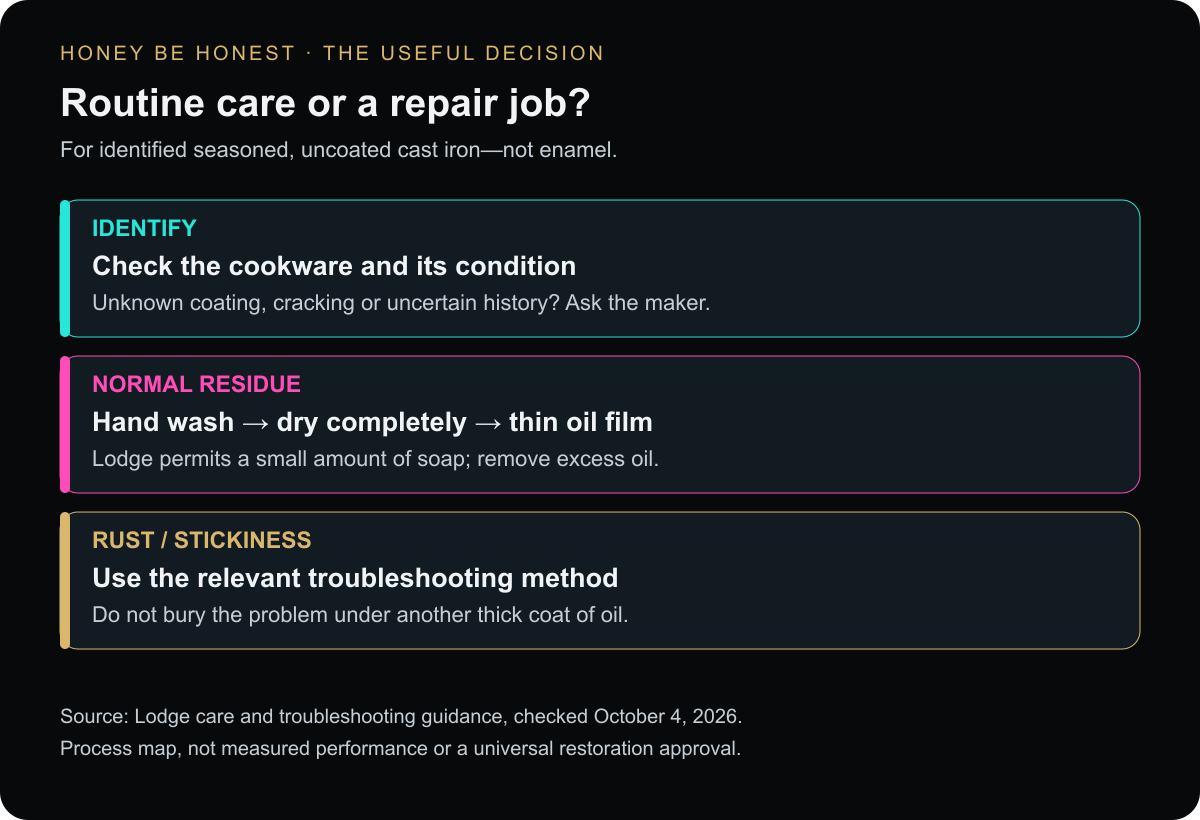
Visual in words: IDENTIFY: Check the cookware and its condition: Unknown coating, cracking or uncertain history? Ask the maker.. NORMAL RESIDUE: Hand wash → dry completely → thin oil film: Lodge permits a small amount of soap; remove excess oil.. RUST / STICKINESS: Use the relevant troubleshooting method: Do not bury the problem under another thick coat of oil.. Source: Lodge care and troubleshooting guidance, checked October 4, 2026. Process map, not measured performance or a universal restoration approval.
This is a sourced process map, not a numerical performance score. There is no invented “seasoning strength” rating, fixed lifetime guarantee or claim that a certain number of oil layers works for every kitchen.
Build a care station you will actually use
Keep an appropriate brush or scraper, a drying towel and your chosen oil accessible. You do not need all of them displayed like a laboratory. You do need to avoid storing the pan wet because the towel lives behind three appliances and a bag of holiday napkins.
If a large skillet is unpleasant to wash or move, treat that as useful buying information. A maintenance routine cannot make a too-heavy pan lighter. Choose cookware that fits your cooking, safe handling and cleanup habits rather than proving loyalty to a particular material.
Does soap automatically ruin seasoning? Lodge’s guidance says a small amount is acceptable. Follow the actual cleaning directions rather than the absolute rule.
Is this the same as enamel care? No. Enamel is a different surface with its own instructions. Do not apply bare-iron scraping or reseasoning procedures to it by default.
Can I use a kitchen scale to compare skillet weight? Do not place hot cookware on one, and respect its capacity and loading directions. Our kitchen-scale guide is about readable ingredient weighing, not hot-pan handling.
A good skillet is a tool. Keep it clean, dry and appropriately maintained—and save the family mythology for the recipe worth passing down.


Leave a comment