
The flour in your pantry does not become immortal because you put it in a pretty jar. Good storage means knowing what flour it is, protecting it appropriately, and buying an amount that matches how often you actually bake. The container is supporting cast. The label is doing more work than the coordinated lid.
The biggest distinction is between refined white flours, such as ordinary all-purpose flour, and whole-grain or nut flours. Their storage needs are not identical. This guide focuses on everyday home baking, not a long-term emergency-food plan.
Honey’s quick take
- Amazing habit: keep the flour identity, date and lot information. Decanting should not erase the evidence you may need later.
- Good for slower use: sealed cold storage where the maker recommends it. Whole-grain and nut flours deserve particular attention.
- Mid strategy: buying the biggest bag because it costs less per pound. A bargain you throw away has excellent packaging and terrible math.
Disclosure: As an Amazon Associate I earn from qualifying purchases. Qualifying links elsewhere on HBH may earn a commission at no extra cost to you. No particular storage-container purchase is required by this guide.
Evidence checked October 4, 2026: King Arthur Baking’s flour-storage guidance and FDA/CDC flour-handling advice. Shelf-life recommendations depend on the flour, package, storage conditions and manufacturer. We have not conducted a storage-life experiment, and the artwork is conceptual.
First decide which flour is in the bag
Flour category: Refined all-purpose or bread flour
Main storage consideration: Keep appropriately sealed in a cool, dry place; follow the package
Useful household response: Buy a size you use and retain the original information
Flour category: Whole-grain flour
Main storage consideration: Oil-rich grain components make quality deterioration more of a concern
Useful household response: Consider sealed freezer storage for slower use
Flour category: Nut flour
Main storage consideration: Contains fat and may have a shorter useful shelf life than white flour
Useful household response: Follow its specific label; cold storage may be appropriate
Flour category: Unknown or recalled flour
Main storage consideration: A jar cannot establish identity or safety
Useful household response: Do not guess or keep recalled product
King Arthur explains that whole-grain and nut flours contain fats that can oxidize after milling, and recommends freezer storage when they will not be used within the expected period. That does not establish one universal expiration date for everything called flour. King Arthur storage guide.
Keep the package information even when you decant
Our practical suggestion is to save the brand, exact flour type, best-by date and lot code. You can retain the original bag with the container or copy the information accurately onto a label while keeping a photograph for reference. Do not photograph only the attractive front if the useful code is on the seam.
This matters for more than organization. All-purpose, bread, self-rising, whole-wheat and nut flours are not automatic substitutes in every recipe. An elegant row of anonymous pale powders is not a baking system; it is a quiz you set for yourself.
Avoid continually topping up an older container without tracking what was already inside. Finish the earlier batch, clean and dry the container appropriately, and refill according to its instructions. That is a simple editorial workflow for maintaining identity and rotation, not a claim that washing a container resets the age of its contents.
Keep a clean, dry scoop and protect the flour from moisture and contamination. A storage habit should make it easier to follow the product’s directions, not replace them with an invented promise that a certain lid grants extra months.
Match storage to how fast you bake
If you use refined flour frequently, a suitable cool, dry location and a properly closed package or container may fit your routine. If the bag lingers, consider the maker’s longer-storage recommendations rather than leaving it in a warm corner indefinitely. King Arthur identifies the freezer as a useful longer-term option. Flour-storage guidance.
Whole grains include the oil-rich germ. King Arthur’s whole-grain guide prioritizes airtight freezer storage for maintaining flavor, with refrigeration as another option. Its quality guidance is not a guarantee that a particular bag remains safe or fresh for a fixed number of months under any conditions. Whole-grain storage guidance.
Make cold storage usable. Put the flour somewhere you can identify and retrieve it, in suitable sealed packaging. A mystery bag behind the frozen vegetables is not meaningfully better organized than one behind the pantry cereal.
Follow the recipe when temperature matters. King Arthur notes that many recipes tolerate flour straight from cold storage, but do not apply that statement to every dough or procedure. If your recipe specifies ingredient temperature, that instruction still has a job.
A date helps; it does not tell the whole story
King Arthur advises assessing storage conditions and quality rather than treating every flour as identical. Its discussion of older flour also emphasizes using suitable storage and buying with realistic usage in mind. This is not a recommendation to ignore a package or use flour whose condition is questionable. King Arthur on older flour.
Do not taste raw flour to judge it. Do not assume that a normal smell proves it is pathogen-free. Quality deterioration and microbiological safety are different questions, and neither gets solved by stirring the bag into a more attractive container.
If you find pests, moisture damage, an unexplained odor or flour of unknown history, be cautious. If there is a recall, follow the recall instructions; the FDA says not to keep recalled flour. Saving a fraction of a bag is not the place to practice determined optimism.
The useful visual: choose a storage path, not a made-up expiry chart
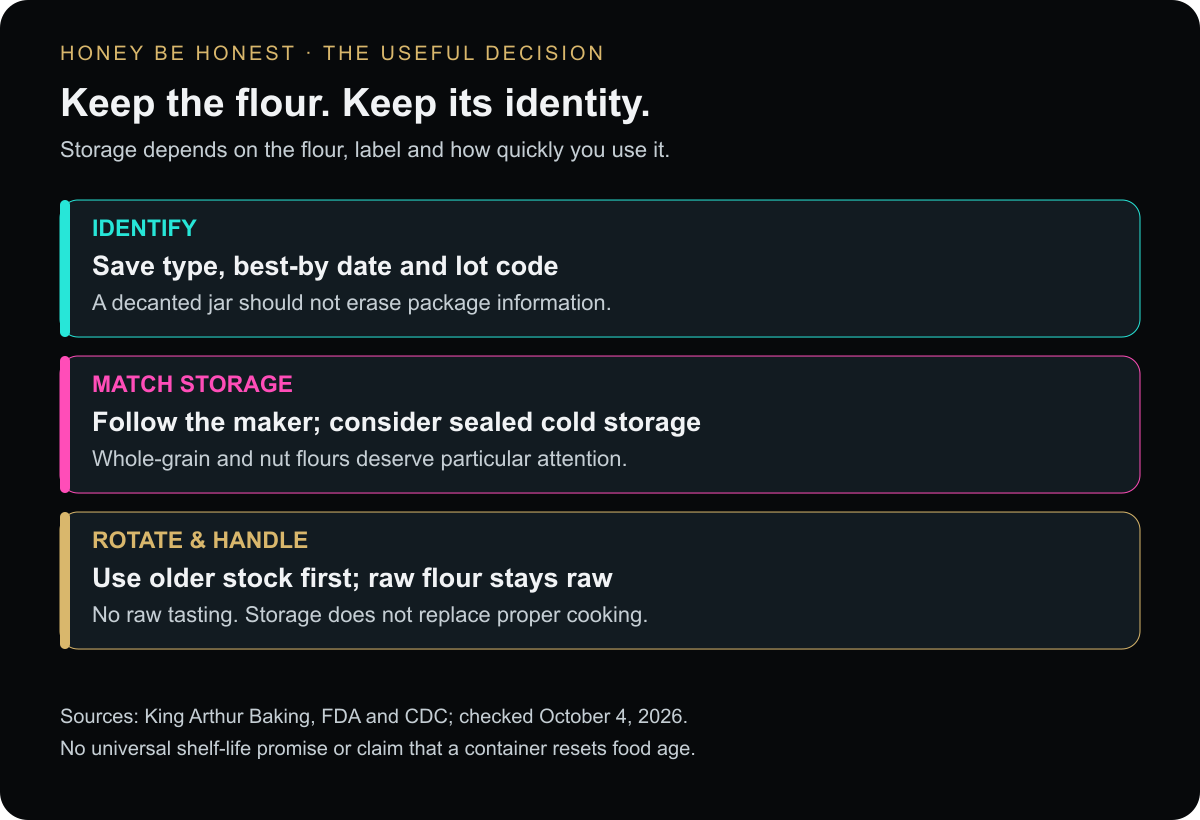
Visual in words: IDENTIFY: Save type, best-by date and lot code: A decanted jar should not erase package information. MATCH STORAGE: Follow the maker; consider sealed cold storage: Whole-grain and nut flours deserve particular attention. ROTATE & HANDLE: Use older stock first; raw flour stays raw: No raw tasting. Storage does not replace proper cooking. Sources: King Arthur Baking, FDA and CDC; checked October 4, 2026. No universal shelf-life promise or claim that a container resets food age.
This map follows the cited manufacturer and food-safety guidance. It deliberately avoids a universal “pantry versus freezer lifespan” graph because we do not have controlled, comparable data for your flour and storage conditions.
Raw flour is still raw
FDA explains that milling does not reliably remove harmful bacteria. Do not eat or taste raw flour, dough or batter, and do not try to make flour safe to eat raw through a home heat-treatment experiment. Follow the cooking instructions for the product or recipe. FDA flour safety.
CDC also recommends separating raw flour and eggs from ready-to-eat foods and cleaning hands, tools and surfaces after handling them. Flour spreads easily; a dusting on the counter is still food handling, not harmless decoration. CDC raw-flour guidance.
Make the next bag an easier decision
Look at how much flour your regular recipes use and how often you make them. Buy for that pattern, not for the imaginary version of you who begins a bakery every Sunday. A smaller bag used well can be the more economical choice even when its unit price is higher; actual savings depend on prices and waste, which we have not measured here.
For recipes that specify grams, a readable scale helps keep measurement consistent. Our OXO, Escali and Etekcity scale comparison covers that separate buying decision.
Keep the label, choose appropriate storage, and use what you buy. The pantry does not need to win a photo contest. It needs to help you bake something worth eating.


Leave a comment