
The Verdict
If your alarm sounds like a forklift reversing into your last nerve, a sunrise alarm clock is a more civilized idea. The useful question is how much bedside fuss you want to manage. For a balance of gradual light, sound choices and ordinary clock duties, the Philips HF3520/60 is my Amazing pick. The Philips HF3650/60 is Good for someone who specifically wants an evening breathing routine. Lumie Bodyclock Spark 100 is Mid for sound variety, but potentially the best fit for a person who wants a light, an optional beep and everyone else to calm the hell down.
These are use-case judgments based on the features below, not laboratory scores or a promise that any lamp will turn a committed night owl into a cheerful breakfast host. We checked the exact US Amazon listings and manufacturer information on September 20, 2026. Seller, condition, delivery and price can change. Read the model number before buying; similar-looking lamps do not necessarily have the same controls.
The three clocks, without the bedside sales pitch
The Comparison
| Model and exact shopping link | Best reason to choose it | Reason to pause |
|---|---|---|
| Philips SmartSleep HF3520/60 (paid link) | Colored sunrise/sunset, five wake-up sounds and FM radio | You want phone control or an elaborate evening program |
| Philips SmartSleep HF3650/60 (paid link) | Seven wake-up sounds plus RelaxBreathe wind-down guidance | You would never use the extra evening features |
| Lumie Bodyclock Spark 100, white (paid link) | A simple 30-minute sunrise/sunset and optional beep | You want nature sounds or a radio in the clock |
This comparison is about bedside wake-up lights. It is not a recommendation to treat a sleep disorder, and the products are not interchangeable with prescribed treatment or a specialist light-therapy plan. The purchase decision here is about controls, audio and a routine you might actually follow.
Amazing for a straightforward upgrade: Philips HF3520/60
The HF3520/60 (paid link) makes sense if your wish list is specific: gradual light, a choice of sounds and a radio, without adding another phone-managed object to your life. Philips lists five wake-up sounds and 20 brightness settings. Its colored sunrise and sunset features cover both ends of the day. Those are practical functions to compare; a dramatic lifestyle photograph is not a feature.
My reason for putting this first is restraint. It offers enough choice to avoid being trapped with one irritating alarm noise, but the buying case does not depend on you becoming the sort of person who lovingly configures an evening wellness program. If you mostly need to wake up and locate pants, that matters. The bedside lamp function also makes the space it occupies easier to justify.
The limitation is equally plain: this is not the model to buy because you assume the word SmartSleep means smartphone controls. Plan to use its own controls. Look closely at the manual before buying if small buttons, symbols or night-time operation are difficult for you. A specification can tell us which controls exist; it cannot tell us whether your half-asleep hand will enjoy using them.
For the underlying features, see Philips’ HF3520/60 product information. We are comparing this exact model, not importing features from a different Philips generation.
Good when evening matters: Philips HF3650/60
The HF3650/60 (paid link) adds a stronger evening argument. Philips describes RelaxBreathe as guided breathing using changing light or sound. It also lists seven wake-up sounds and three relaxation sounds. That makes it worth considering if you want one bedside device to signal both ‘start your day’ and ‘stop reading the internet’s latest argument.’
However, buying more features only helps if you will use them. Before choosing this model, describe your real bedtime in one sentence. If it involves an intentional wind-down and a willingness to learn the controls, the extra program has a job. If it involves falling asleep with a remote in one hand and tomorrow’s worries in the other, pay attention to the basic alarm functions first.
The manufacturer’s specification sheet explicitly says this HF3650/60 is not controlled by a smartphone and does not have an app alarm scheduler. Do not borrow the connected features of similarly named models. That distinction matters more than the shape of the lamp. The model also has FM radio; seven built-in wake-up choices do not mean an unlimited streaming library.
See Philips’ HF3650/60 description and its model-specific specification sheet. My Good rating is about the fit for a reader who values wind-down tools; it is not a judgment that its light is worse than the cheaper option.
Mid for audio choice, appealing for simplicity: Lumie Spark 100
The Lumie Bodyclock Spark 100 in white (paid link) uses a 30-minute sunrise and sunset, adjustable final sunrise intensity and an optional alarm beep. Lumie also describes a light-sensitive display that dims at night. That is a clear, contained job description. No imaginary choir of forest creatures is required.
Its drawback is sound variety: the Spark 100 has one beep option, rather than the Philips choices. If the sound is the thing you currently hate, do not assume a light automatically solves that objection. If you want to try waking with light while retaining an audible backup, the simple design may be exactly the point. Mid here means limited audio choice for this comparison, not a claim of poor build quality.
This is also the one I would examine carefully for routine simplicity. A fixed half-hour transition removes one setting to debate. On the other hand, someone who knows they want a different sunrise duration should verify the available controls before committing. Buy the routine you want, not the number of options you can brag about at a dinner party nobody requested.
The Lumie Spark 100 product page supports these functions. Our shopping link is the US white listing observed on Amazon; UK website prices, trial periods and regional warranty language are not automatically terms of that Amazon purchase.
The Chart
A useful graph: how many built-in wake-up sounds?
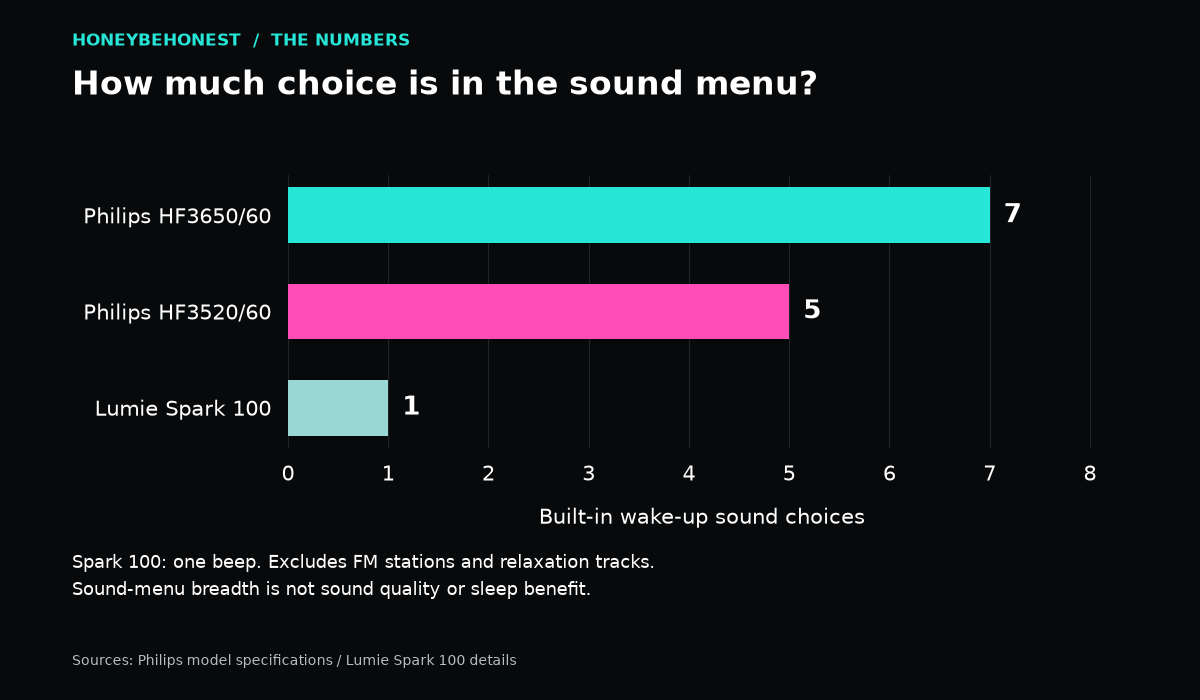
| Model | Sound choices shown as blocks | Count |
|---|---|---|
| HF3520/60 | ■ ■ ■ ■ ■ | 5 |
| HF3650/60 | ■ ■ ■ ■ ■ ■ ■ | 7 |
| Spark 100 | ■ | 1 beep |
Source: the model-specific Philips information and Lumie product details linked above. This counts onboard wake-up choices, excluding FM stations, relaxation-only tracks and anything streamed from another device. More sounds means more choice, not a louder alarm, better speaker or better sleep. The Spark’s one is a beep, so the bars compare menu breadth rather than claiming equivalent sound experiences.
Before a sunrise clock moves onto your nightstand
Check the available space and reach the proposed location from bed. The controls must be accessible without knocking over your water glass. Think about where the light points, whether you sleep facing away from it, and whether a partner gets up later. A device can match every item on a product page and still be an inconsiderate roommate when aimed at the wrong person.
During the first few mornings, keep an independent alarm you already trust. Experiment with the lamp’s settings when missing a wake-up time is not disastrous. Do not interpret a gentle design as a guarantee that light alone will wake you. Also read the exact manual’s power-interruption behavior; a mains-powered lamp and a battery-backed phone are different things.
Give bedtime the same practical attention. Decide whether the lamp replaces an existing light or simply adds another object. If your actual goal is fewer phone distractions, a separate clock can support that boundary only if the phone leaves arm’s reach. For a screen dedicated to reading, our Kindle comparison looks at a different part of that bedside setup.
What I would buy for each kind of morning
Choose the HF3520/60 for a balanced, self-contained wake-up light with several sound options. Choose the HF3650/60 when the guided evening features are something you specifically want. Choose Spark 100 when a predictable light routine matters more than audio variety. Check the exact seller’s return terms so you can assess the controls and placement in your own room.
The winning lamp does not have to make you a morning person. Honestly, that sounds like a personality transplant and we have errands. It needs to do a manageable job reliably in your routine, with controls you understand and an alarm plan you trust. That is a much better buying standard than believing a glowing circle will organize your entire life.
The Story
Morning gadgets love to promise a new life where we stretch at dawn and drink lemon water before anyone speaks to us. I am aiming lower. If the alarm wakes me without making me want to throw it through drywall, we are already making progress.
Honey’s Bottom Line
Morning rule: if the alarm clock requires a 14-step ceremony before sunrise, somebody is going back to the old phone alarm. Honey wants gentler mornings, not a new morning hobby.
Disclosures
Affiliate disclosure: As an Amazon Associate I earn from qualifying purchases. When you use an Amazon link in this article, HBH may earn a commission at no extra cost to you.
Editorial disclosure: This is a research-based comparison using published manufacturer information and the linked product listings. Unless specifically stated, this is not a report of hands-on testing or personal use.
Artwork disclosure: The cover image is AI-generated Honey Be Honest editorial artwork and is illustrative; it is not a photograph of the exact products compared.


Leave a comment