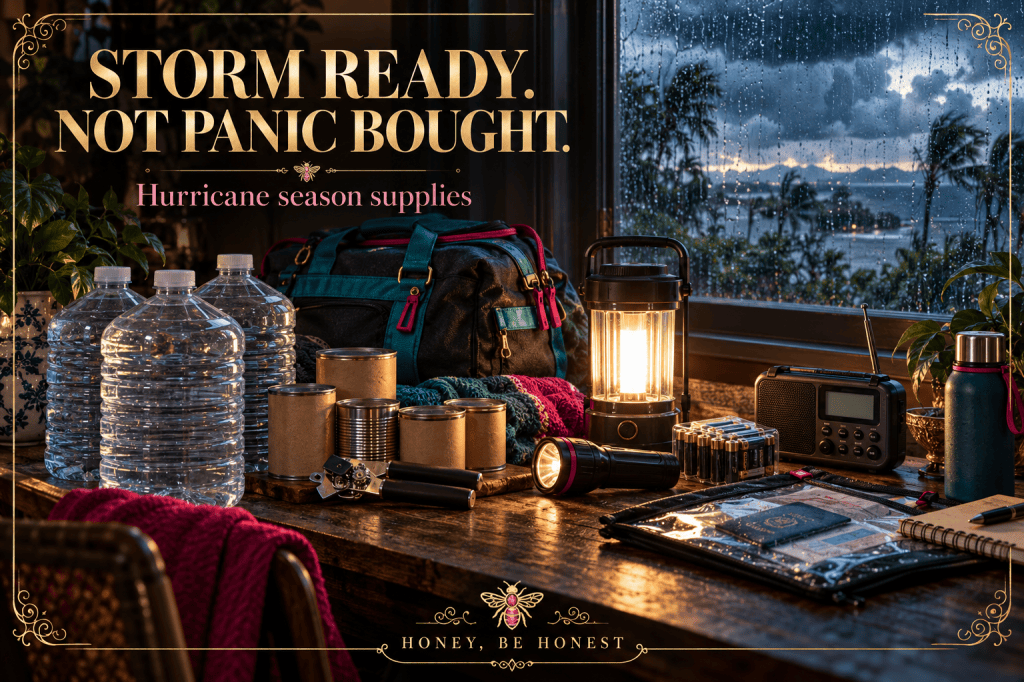
VERDICT: I build hurricane supplies in this order: evacuation plan, water, food, medications, warnings, light and charging. Gadgets come after the boring essentials because the boring essentials are the ones doing most of the work.
Start with your evacuation plan, water, food, medication needs and a way to receive warnings. Add lights and useful charging equipment after you know what the household already has. A dramatic-looking emergency gadget is not a substitute for the boring essentials—and the boring essentials are doing most of the work.
This is a household preparedness guide, not a forecast for your address. Follow your local emergency officials’ instructions, including evacuation orders. A stocked closet is not a reason to stay somewhere authorities tell you to leave.
Disclosure: As an Amazon Associate I earn from qualifying purchases. I may earn a commission from qualifying links at no extra cost to you. You do not need a branded kit to use this checklist. Official safety guidance is linked throughout.
How this guide was prepared: I checked National Weather Service and CDC guidance on October 4, 2026. The water chart is arithmetic derived from a published planning baseline, not a test of supplies or a prediction of outage duration. This is a source-based planning guide; it does not present measured equipment performance.
First decide where the supplies need to go
The National Weather Service recommends knowing your evacuation area, reviewing a family communication plan and checking emergency equipment before a hurricane. Write down where you would go and how you will contact each other. Keep the plan where it remains accessible if your usual device or connection fails. NWS preparation guidance
For shopping purposes, think in two groups: what stays in the home and what must leave with you. This is an organizational choice, not a different safety standard. A storage bin may work nicely on a shelf and poorly when one person needs to carry it, a pet carrier and other necessities.
Assign actual jobs. Who checks the water? Who gathers medications and documents? Who knows where the flashlight batteries live? “I have stuff somewhere” is a family tradition, not an inventory.
Water: do the arithmetic before admiring the container
The NWS kit guidance adapted from Ready.gov uses one gallon per person per day for drinking and sanitation, for at least three days. Individual circumstances can require more. Plan separately for pets and additional household needs; this baseline does not calculate every use of water in your home. NWS emergency-kit guidance
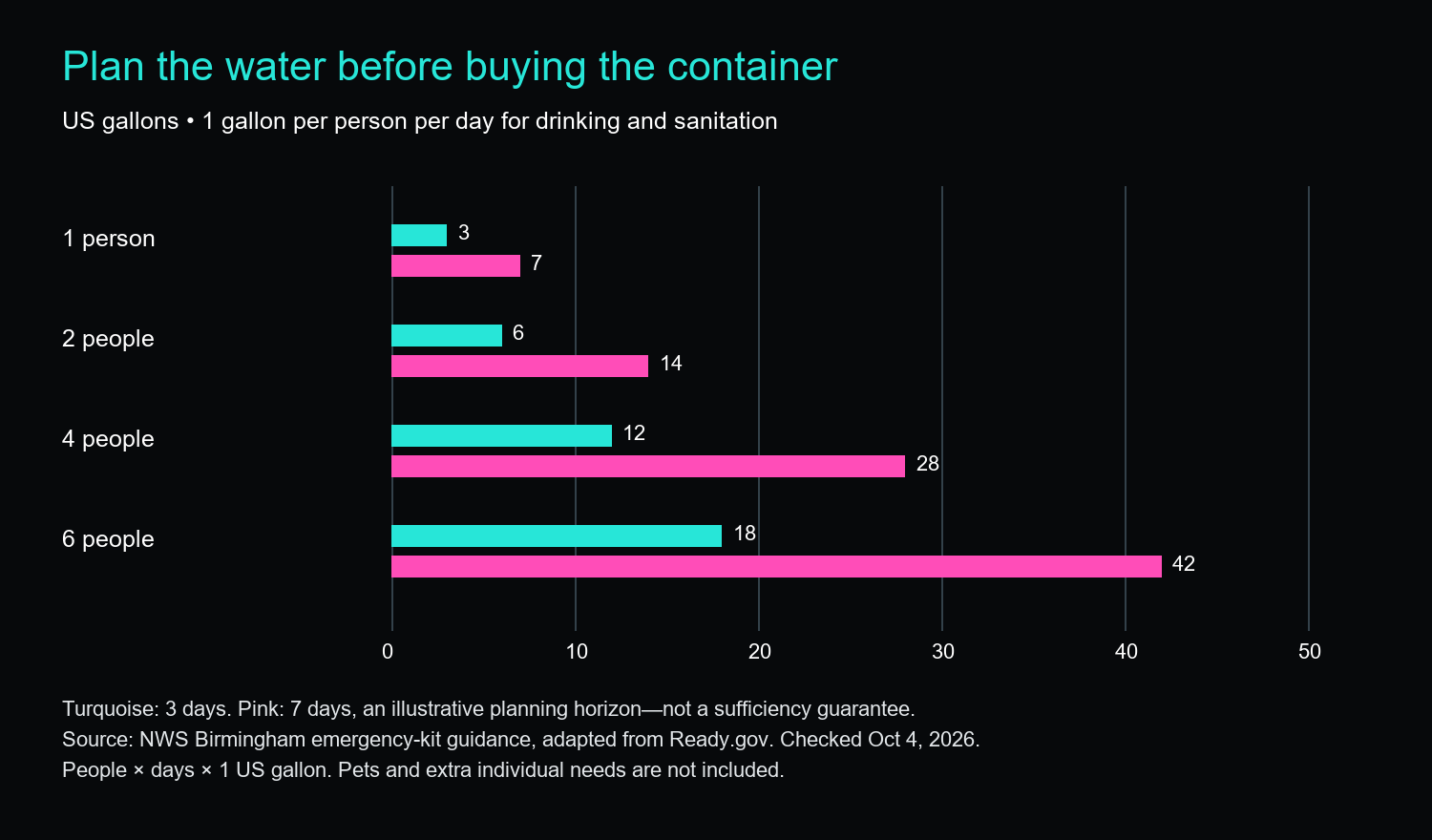
Open the water-planning graph at full size. Values in US gallons, three days / seven days: 1 person, 3 / 7; 2 people, 6 / 14; 4 people, 12 / 28; 6 people, 18 / 42. Extra needs and pets are additional.
The three-day bars are people × 3 days × 1 gallon. The seven-day bars show a longer illustrative planning horizon, not a promise that seven days will be sufficient or a rule about when to evacuate. For four people, that calculation is 12 gallons for three days or 28 gallons for seven. The calculation is simple; making room for it is the part that deserves attention.
Count what you actually have in usable storage. A water container with a very impressive capacity contains exactly zero drinking water until you fill it appropriately. A filter also is not the same thing as a stored supply, and its usefulness depends on the contaminant and the product’s verified capabilities. Do not assume any filter makes floodwater drinkable.
Make the storage plan practical enough to maintain. Record quantities and replacement dates using the product instructions. Choose containers and locations that the people in the household can manage. The prettiest stack is not helpful if nobody can move what needs to go into the car.
Food: buy meals your household can eat without a project
NWS hurricane guidance calls for at least three days of non-perishable food, water and medicine, with a longer disruption possible. It also specifically reminds households to include pets. NWS hurricane preparedness
Translate that into ordinary meals rather than a mysterious total of “servings.” Count breakfasts, lunches, dinners and snacks for the actual people. Check dietary needs, preparation requirements and how much water the food requires. If you normally dislike it, three uncomfortable days probably will not launch its comeback tour.
A pantry-based plan can be easier to rotate than unfamiliar emergency food. Keep the manual can opener with the supplies if cans are part of the plan. NWS’s disaster-kit list includes one alongside food and basic hygiene items. NWS kit list
Do a small rehearsal while everything works: choose one planned meal and assemble whatever you would need to eat it. That can expose an ordinary missing utensil without buying another entire bundle.
Medication and personal needs come before optional gear
The household plan needs to account for prescriptions, glasses, infant supplies and other individual needs. NWS includes first aid and prescription medicines in its family supply guidance. NWS household supplies
Make a written list of what each person uses and what would become difficult during an outage or evacuation. For prescription storage, refills or powered medical equipment, work out the specific plan with the relevant clinician, pharmacist or equipment provider before an emergency. A generic article cannot tell you that a particular battery will safely support someone’s treatment.
Do not turn this into an excuse to buy an enormous medical kit you do not know how to use. The useful question is whether the supplies match the household and whether someone knows where they are. Keep important instructions with the equipment rather than relying on remembering a website password under pressure.
Lights, alerts and charging: give each purchase one job
NWS recommends extra cash, a battery-powered radio and flashlights for the aftermath. It notes that water and power can be unavailable beyond the storm itself. NWS hurricane supplies
Audit the equipment you own before shopping. Turn it on. Check the correct battery type and condition. Put matching spare batteries where the device lives. A drawer containing seventeen batteries in the wrong size is a collection, not backup power.
Light a task or route through the home
What to check before buying: Controls, battery type, where it will be kept
Easy mistake to avoid: Buying brightness without checking runtime or spares
Receive weather information
What to check before buying: Actual receiving/alert features and setup instructions
Easy mistake to avoid: Treating a product name containing “NOAA” as proof every feature is present
Charge a phone
What to check before buying: Compatible cable and output, usable capacity and recharging plan
Easy mistake to avoid: Buying a battery but forgetting the cable
Keep selected equipment running
What to check before buying: Device load, required runtime and exact compatibility
Easy mistake to avoid: Confusing a watt rating with hours of backup
Use these checks to identify what your household actually needs. Test the intended setup before you depend on it. Keep a printed list of essential contacts with your plan; the plan should not disappear with a flat phone.
Power stations and fuel-burning generators are different decisions
A battery power station stores electrical energy. A fuel-burning generator produces power from fuel and brings exhaust hazards. Calling either one a “mini generator” does not tell you its output, runtime, safe placement or suitability for a particular device.
My existing Anker C1000 Gen 2 vs C1000 vs EcoFlow DELTA 3 Plus guide compares battery power stations. It is a separate equipment decision, not a claim that buying one completes a hurricane kit. Check current specifications and exact accessories before purchasing; an old article is not a live stock guarantee.
One optional equipment example: the Anker SOLIX C1000 Gen 2 standalone power station has a listed 1,024Wh capacity and 2,000W rated AC output. Those are capacity and output specifications, not a promise of runtime for your appliances. It can be a useful upgrade for selected compatible loads after the essential supply gaps are covered; it is an expensive way to solve only a phone-charging problem.
My October 4 listing check showed the standalone station sold and shipped by AnkerDirect, with an AC charging cable, Quick Start Guide and safety/warranty information. Solar panels were not included in that selected offer. Amazon displayed a non-returnable hazardous-material transportation notice, so read the current return terms carefully before ordering. Offers can change. Check the exact C1000 Gen 2 standalone listing and current terms.
For fuel-burning generators, CDC says to operate outdoors, more than 20 feet from windows, doors and vents—not inside a home or garage even with doors open. Use battery-powered or battery-backup carbon-monoxide alarms in the home. CDC also warns against indoor charcoal burning and portable gas camp stoves. CDC carbon-monoxide guidance
If you cannot use equipment in accordance with its safety requirements, do not improvise an indoor workaround. This article does not provide a generator wiring plan or establish that a generator is suitable for your property. Fuel storage, weather protection and electrical connections need their own exact instructions and appropriate professional advice.
Documents, hygiene and pets deserve their own checklist
Keep copies of essential records accessible and protected from water, along with needed keys and cash. NWS’s family guidance includes personal supplies and items for household members with additional needs. NWS family planning
For pets, list food, water, medication, transport and identification needs. Do not assume the place you intend to stay will accept every animal or provide supplies. Check arrangements before leaving becomes urgent. NWS specifically includes pets in evacuation planning. NWS hurricane planning
Organize hygiene supplies where they can be found without unpacking everything else. Label the containers by function. The objective is not a photogenic emergency closet; it is making the next useful item easy to reach.
Your household inventory: fill this in before shopping
Write the number of people and pets, your planned supply period and your evacuation destination at the top. For each row, record what you have checked and the next action; use separate home-storage and take-with-you lists where needed.
Water
Household quantity or detail to record: People × days × 1 US gallon; add extra needs and pets separately
Status and next action: Gallons present: ___; gap: ___
Food and can opener
Household quantity or detail to record: Meals for the planned period; dietary and preparation needs
Status and next action: Checked: ___; replace/buy: ___
Medications and individual supplies
Household quantity or detail to record: Personal list and storage/refill plan from the appropriate provider
Status and next action: Plan confirmed: ___; next action: ___
Lights, radio and batteries
Household quantity or detail to record: Device locations, correct battery types and working checks
Status and next action: Working: ___; missing: ___
Phone charging and contacts
Household quantity or detail to record: Compatible cable, charged supply and printed essential contacts
Status and next action: Tested: ___; next action: ___
Records, keys, cash and hygiene
Household quantity or detail to record: Protected, accessible location; what leaves with you
Status and next action: Packed/located: ___
Pets and evacuation arrangements
Household quantity or detail to record: Food, water, transport, identification and destination arrangements
Status and next action: Confirmed: ___; gap: ___
This checklist organizes the NWS guidance linked above. It does not replace evacuation orders, individual medical instructions or equipment manuals. Set a date to recheck supplies and any replacement dates listed on their packaging.
A better shopping order
Start with an inventory. Mark each item as present and checked, needing replacement, or missing. Fill the essential gaps first. Then consider equipment upgrades that solve an identified problem. Avoid spending the entire budget on one dramatic box while leaving the routine needs unfinished.
Before you call the kit done, ask three practical questions: Can the household find the supplies? Can the people using them operate them? Can you take what you need if told to leave? If one answer is no, fix that before chasing another feature.
Preparedness does not need to look impressive. It needs to be ready when an ordinary convenience stops being available.
Honey, Be Honest: Why I Went Looking
I went looking because emergency-shopping lists have a bad habit of turning into camping catalogs. A tactical flashlight with fourteen modes is adorable, but it does not hydrate anybody. I would rather have boring water, boring medication and a boring radio than a very exciting cart that forgot the actual emergency.


Leave a Reply