The Verdict
For a laptop bag that needs useful power without a separate cable scavenger hunt, Anker's A1695 25K is my Amazing pick. The A1340 Prime 27,650mAh is Good when a compatible laptop can benefit from its higher single-port output. The A1339 Prime Fusion is Mid for a long stretch away from an outlet, but its built-in wall plug makes sense for lighter travel and shorter top-ups. The right answer depends on the laptop, not on which box has the biggest number shouting at you.
This is a researched comparison of three specific models, not an HBH battery-runtime test. Manufacturer specifications and the linked Amazon listings were checked September 20, 2026. I have not spent a week timing these in an airport lounge while pretending that airport coffee is a personality. No charging-speed or endurance result below is an invented personal experience.
| Exact model | HBH fit | Power distinction |
|---|---|---|
| Anker A1695 25K, silver (paid link) | Amazing: built-in cables | 100W single USB-C; 165W two-USB-C total |
| Anker Prime A1340 27K, black; no base (paid link) | Good: higher single-port power | 140W single USB-C; 250W shared maximum |
| Anker Prime Fusion A1339 9.6K (paid link) | Mid: long unplugged laptop sessions | 65W battery-mode maximum; built-in AC plug |
Start with the laptop's actual charging requirements
A USB-C connector does not automatically mean that a laptop accepts USB-C charging, or that it can use every watt a power bank advertises. Check the computer maker's charging requirements and the cable specification. A machine designed around a large dedicated power adapter may charge slowly, reduce performance, or decline a lower-power source under load. The battery cannot negotiate away the laptop's requirements through positive thinking.
Also separate three numbers: single-port output, shared output across devices, and stored energy. Watts describe the charging rate available under suitable conditions. Capacity describes the reservoir. A high-power bank can still have a relatively small reservoir, just as a large coffee mug does not guarantee a strong cup. We are comparing both jobs, and neither number should impersonate the other.
The exact linked options are the silver A1695 25K with built-in cables, the black A1340 Prime 27,650mAh power bank without the charging base, and the A1339 Prime Fusion 9,600mAh with an AC plug. These are not the older A1335, the newer Prime 26K 300W, or a vaguely similar Anker model that a marketplace selected after a color change.
Amazing: A1695 for everyday laptop-bag convenience
Anker specifies up to 100W from one USB-C connection on the A1695, with a 165W combined maximum when using two USB-C outputs. Its two built-in cables, separate USB-C socket, and USB-A socket reduce the number of loose pieces you need for a practical charging setup. One cable retracts; the other is built into the carry-loop arrangement. This is my favorite here when remembering the cable is half the battle.
There is an important limit behind the big 165W headline: one laptop does not receive 165W from a single port. Anker's current diagram also reduces the combined allocation for three or four connected devices to 130W. Plugging in every gadget can change the charging budget. Four available connections are not four unlimited electrical buffets.
The convenience comes with weight and less choice about the built-in cables. Anker lists 595 grams, so it is a bag item rather than something I would casually forget in a thin shirt pocket. A built-in cable is wonderfully hard to leave on a hotel desk, but it is also part of the device rather than a cheap separate lead you swap without thinking.
I would buy it for a compatible laptop that can use up to 100W and a person who values a tidy, ready-to-connect kit. I would skip it if the laptop needs a higher USB-C rate to behave as intended or if most trips only require a small phone top-up. Carrying extra capacity is still carrying extra capacity, even when the display looks very pleased about it.
Good: A1340 Prime when higher single-port power matters
The A1340 Prime advertises 250W shared output, with a maximum of 140W on a suitable USB-C connection. Its 27,650mAh nameplate capacity is somewhat larger than A1695's 25,000mAh, but this is not evidence of proportionally longer laptop runtime. Conversion losses, operating conditions, charging behavior, and what the computer is doing all affect the usable result.
I would choose it when a compatible laptop can actually take advantage of the higher single-port ceiling. That is a specific reason to upgrade. Buying 140W capability for a laptop that only accepts 45W is not forbidden, but it is not a speed upgrade for that laptop. Read the computer's specifications before paying for a number it cannot use.
Anker lists a 665-gram body and app-connected features for monitoring and locating the bank nearby. The app connection is Bluetooth; it is not a promise that you can track a lost bag across town. The linked Amazon selection is the black power bank alone. Its title explicitly excludes the charging base, even though product-page material discusses a base bundle elsewhere. Match the selected package, not the most attractive photograph in the listing.
The trade-off is a larger and more involved setup than a small emergency battery. You need the appropriate cable and a suitable way to recharge it. Anker discusses high-power and dual-input recharging arrangements, but those headline times assume the required equipment and conditions. I would not buy an extra charger just to win a charging-time argument I never needed to have.
Mid: A1339 Fusion when the outlet is part of the plan
Prime Fusion A1339 combines a 9,600mAh battery with a built-in AC plug. Anker's current U.S. specification explicitly lists up to 65W in both charger mode and battery mode. It also lists a 65W combined total when both USB-C ports are used, with a 45W-and-20W split. This is not the older model whose power limits somebody may remember from a different review.
That combination makes the Fusion interesting for a lighter routine: use it as a wall charger when an outlet is available and keep some battery reserve for the gap between outlets. I would consider it for a compatible lower-power laptop and a traveler who wants fewer separate objects. A charger that remembers to bring its own emergency battery has an argument.
Its Mid rating is specifically for long laptop sessions away from power. The battery capacity is much smaller than either of the other two. A 65W output rating does not mean 65 watts for an entire afternoon. Think supplementary reserve rather than assuming it can replace the laptop's wall adapter indefinitely.
The current specification separates USB-C recharging input from device output: its battery input reaches 30W, while the output ceiling is higher. Input and output are different jobs. A label that says 65W does not promise every direction and every combination gets 65W. Electricity is annoyingly uninterested in our interpretation of the packaging.
The graph compares one laptop connection
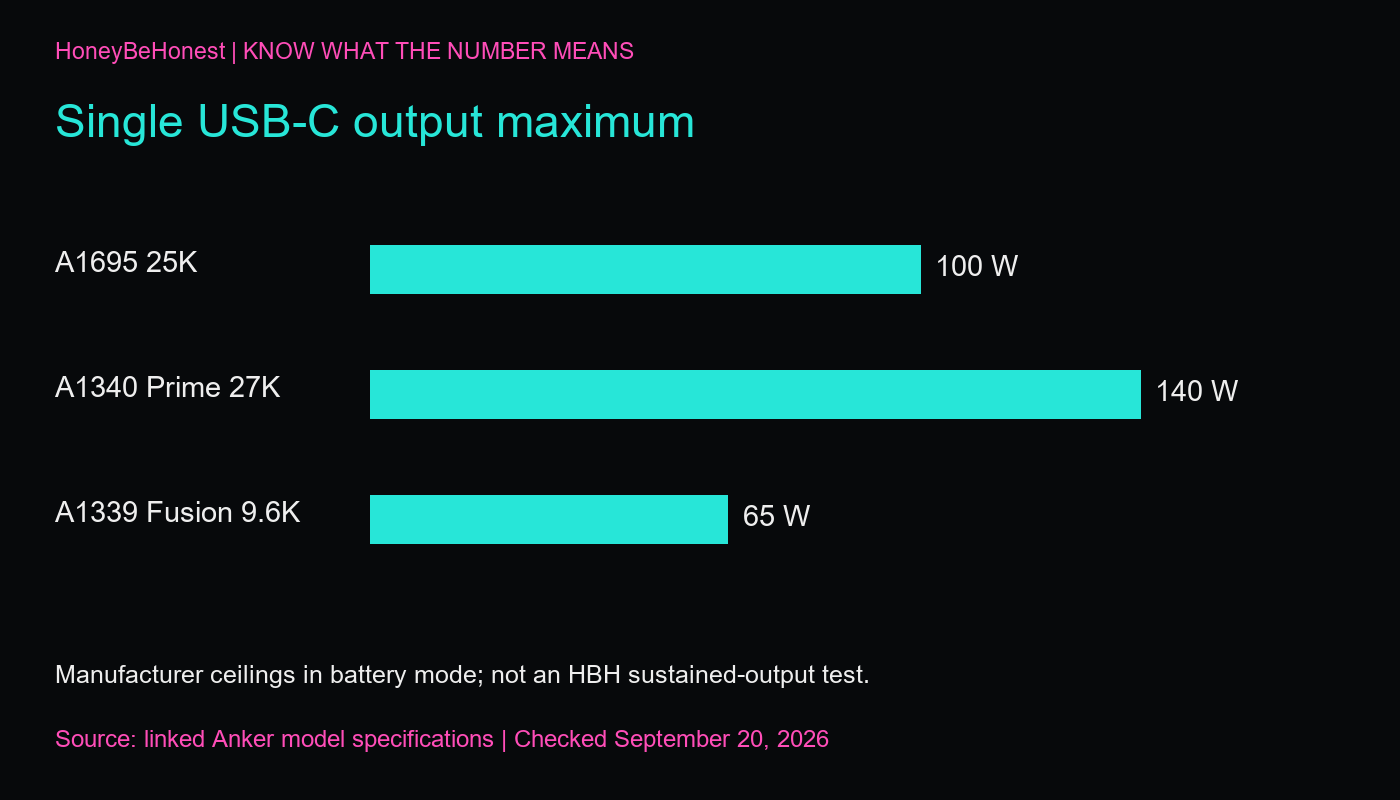
The chart shows manufacturer-stated single-USB-C maximums: 100W for A1695, 140W for A1340, and 65W for A1339 in battery mode. These are ceilings under compatible conditions, not measured sustained outputs, guaranteed laptop intake, or runtime predictions. A faster-looking bar is useful only when your equipment can use the relevant power profile.
For energy, compare watt-hours printed on the actual product rather than dividing the bank's milliamp-hours by a laptop battery number at a different voltage. Keep the unit definitions straight. An impressive calculation with mismatched units is still wrong; it has simply put on a tie.
Recalls, flying, and the last checks before buying
I checked Anker's recall index and the CPSC's September 18, 2025 notice covering A1647, A1652, A1257, A1681 and A1689. The three models in this guide are not the model numbers named in that notice. That is a bounded current check, not a permanent safety guarantee or a reason to ignore a later notice. Check the actual model and serial number against the manufacturer's current recall process.
For flights, the FAA says spare lithium batteries, including power banks, belong in carry-on baggage, with capacity restrictions and protection against damage and short circuits. Airlines can impose stricter conditions. Check your carrier's current rules, the actual battery's watt-hour label, and any restrictions on onboard use; a retailer's “TSA-approved” title is not a personalized boarding pass for your battery.
My choice is A1695 for built-in-cable convenience, A1340 when the laptop can benefit from higher output, or A1339 when a wall charger plus modest reserve is the actual brief. Buy for the computer and the trip you have. The charging aisle has enough drama without inventing a laptop emergency to justify the largest brick.
Check the exact models
View Anker A1695 25K, silver on Amazon (paid link)
View Anker Prime A1340 27K, black; no base on Amazon (paid link)
View Anker Prime Fusion A1339 9.6K on Amazon (paid link)
Sources and related reading
A1695 current U.S. specifications and port allocation
A1340 current U.S. specifications
A1339 battery-mode and charger-mode specifications
CPSC September 18, 2025 specific-model recall
FAA current passenger battery guidance
Need AC outlets and a different class of stored energy? Read our Anker C1000 Gen 2 vs C1000 vs EcoFlow DELTA 3 Plus power-station comparison. Those larger stations answer a different question from a laptop-bag USB power bank.
Honey’s Bottom Line
Power-bank rule: a battery pack should rescue your laptop, not require its own emergency-planning committee. Check the laptop first, then buy the power bank that fits the job.
Disclosures
Affiliate disclosure: As an Amazon Associate I earn from qualifying purchases. When you use an Amazon link in this article, HBH may earn a commission at no extra cost to you.
Editorial disclosure: This is a research-based comparison using published manufacturer information and the linked product listings. Unless specifically stated, this is not a report of hands-on testing or personal use.
Artwork disclosure: The cover image is AI-generated Honey Be Honest editorial artwork and is illustrative; it is not a photograph of the exact products compared.


Leave a comment